
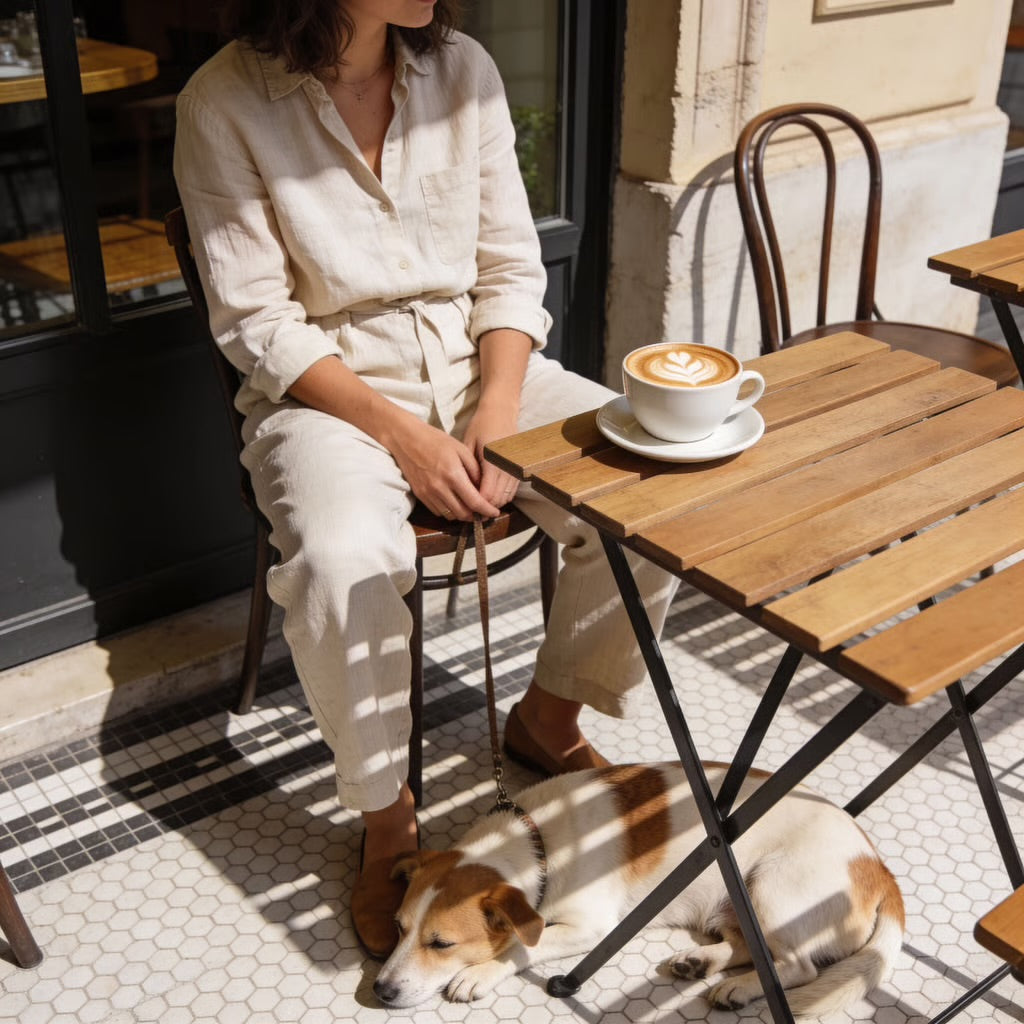
Traveling with dogs is undergoing a fundamental shift. Just a few years ago, the main concern was whether a dog could even come along on vacation. Today, the question has evolved. It's no longer just about "if," but about "how."
- How do you travel so that the dog feels comfortable?
- How do you travel so that you truly unwind yourself?
- And how do you travel so that vacation doesn't become more stressful than everyday life?
This is precisely where a new travel trend begins, one that is increasingly establishing itself in tourism: Calm Travel with Dogs.
Calm Travel doesn't mean experiencing less. It means experiencing more intensely. It means staying longer in one place, traveling more calmly, making more conscious choices, and adapting your own rhythm to the dog's natural rhythm. This travel style is directly related to Slow Tourism, a tourism trend that emerged as a counter-movement to mass tourism and is growing worldwide.
More and more people today are not looking for the spectacular on vacation, but for tranquility. No longer a list of sights, but a feeling of arrival. No longer speed, but time.
And when you travel with a dog, you quickly realize: this very calm way of traveling is the most natural way for dogs.
Calm Travel with Dogs is therefore not just a trend – but a logical development. For tourism. For dog owners. And for a new definition of luxury.
Table of Contents
- What does Calm Travel with a Dog mean?
- Why traditional vacations with dogs are often stressful
- Why Calm Travel with a Dog is the travel trend of the future
- Calm Travel with a Dog in Cities
- The best travel types for Calm Travel with a Dog
- Conclusion: Calm Travel with a Dog as a new definition of luxury
- Frequently Asked Questions
Key take-aways
- Calm Travel with a Dog means peaceful, conscious, and stress-free travel.
- The trend is linked to Slow Tourism and mental well-being travel.
- Dogs benefit enormously from longer stays and fixed routines.
- Cities are possible – but ideally outside of peak season.
- The new luxury in travel is peace, time, and quality instead of speed.
What does Calm Travel with a Dog mean?
Calm Travel with a Dog describes a form of travel where the focus is not on sights or programs, but on quality of stay, peace, and shared time. It's about not just visiting a place, but experiencing it – at your own pace.
Those who travel with dogs quickly realize that dogs perceive the world differently than we do. For them, every new environment is a flood of impressions: new smells, new sounds, new paths, new people. While we often try to see as much as possible in a short time, the dog primarily tries to understand the new environment and find security.
Slow travel helps dogs immensely with this. When they can repeat paths, recognize places, and develop routines, familiarity arises. And familiarity means security. And security means relaxation.
That's exactly why Calm Travel with a Dog works so well: the travel style matches the dog's natural behavior.
Slow Travel with a Dog is therefore often not described as a method, but as an attitude: less program, more presence; fewer changes of location, more time spent; less planning, more experiencing.
Why traditional vacations with dogs are often stressful
Many vacations are not actually designed for dogs, but for people. You often only notice this when you travel with a dog.
Typical traditional vacations include:
- long car rides
- many changes of location
- crowded city centers
- restaurants where dogs are not allowed
- hotels without retreats
- hot temperatures in cities
- crowded beaches
- many new stimuli every day
For dogs, this means constant stress. Not because the dog doesn't want to travel – but because the pace is too high.
Many dogs show signs of stress when traveling, such as:
- panting
- restlessness
- little sleep
- increased reactivity
- loss of appetite
- constantly observing the surroundings
New environments always mean initial insecurity for dogs. Only through repetition does peace emerge. That's precisely why frequent changes of location are one of the biggest stress factors when traveling with a dog.
If you understand this point, you automatically understand why Calm Travel with a Dog works:
Peace arises not from the place, but from time spent in one place.
Why Calm Travel with a Dog is the travel trend of the future
For several years, tourism has been observing a strong development: traveling with dogs is becoming increasingly important for destinations and hotels. Dog owners are a very interesting target group, as they often travel several times a year, are nature-oriented, and place great importance on quality.
A study also shows that while dog owners fly less frequently, they spend a similar amount of money per trip as travelers without dogs. Quality and suitable offerings are more important than price.
This means: traveling with dogs is an economically relevant tourism trend.
And this is exactly where Calm Travel fits in perfectly, because Calm Travel means:
- longer stays
- smaller hotels
- boutique hotels
- vacation homes
- nature regions
- off-season
- individual offers
- high quality of stay
These are precisely the areas in which tourism is currently developing strongly: away from mass tourism, towards individual, high-quality travel experiences.
Calm Travel with a Dog is therefore precisely at the intersection of:
- Slow Tourism
- Wellbeing Travel
- Nature Tourism
- Boutique Hotels
- Remote Work / Workation
- dog-friendly tourism
In other words: Calm Travel with a Dog is not just a dog topic. It is a tourism trend.
Calm Travel with a Dog in Cities
When thinking about a vacation with a dog, most people automatically think of nature: mountains, lakes, the sea, or rural regions. And yes – nature is the most relaxing place for many dogs. But Calm Travel with a Dog does not mean that you have to forgo cities. On the contrary. Cities can be wonderful destinations with a dog – if experienced at the right time and at the right pace.
The biggest mistake when traveling to cities with a dog is not the city itself, but the timing of the trip. A city in August is not the same city as in November. A city on a summer weekend feels completely different from the same city on a Tuesday morning in February.
For people, off-season often means: fewer events, less hustle and bustle.
For dogs, off-season means: less stress, less noise, less crowding, more space to move, and more peace.
And that's precisely why a city trip fits perfectly with the concept of Calm Travel with a Dog – as long as it's planned consciously. Imagine a city not as a sightseeing spot, but as a temporary living space. Not five sights per day. But a rhythm.
- A morning walk through quiet streets.
- A café at noon.
- A park in the afternoon.
- A restaurant in the evening.
- Breaks in between. Sleep. Routine.
Then a hectic city trip suddenly turns into a quiet everyday life in a new place. And that's exactly the idea behind Calm Travel with a Dog: You don't travel to see as much as possible. You travel to live in a different place for a while.
Cities in particular can be perfect for this because they combine many things:
- long walking paths
- parks
- cafés
- restaurants
- architecture
- culture
- beautiful paths for strolling
- often very dog-friendly infrastructure
The crucial point, however, is that the city must be quiet enough for the dog to orient itself. And this is almost always only outside the main season.
Comparison: City trip with dog – peak season vs. off-season
|
Factor |
Peak Season |
Off-Season |
|
Crowds |
very high |
low |
|
Temperatures |
often hot |
pleasant |
|
Restaurants |
full |
relaxed |
|
Hotels |
noisy |
quiet |
|
Walks |
stressful |
peaceful |
|
Dog Stress |
high |
low |
|
Prices |
high |
lower |
|
Atmosphere |
hectic |
calm |
If you look at this table, you quickly realize: The off-season is actually the better travel time – especially with a dog.
Many cities show their most beautiful side only outside of peak season. The streets are emptier, cafés are more relaxed, hotel rooms are quieter, and walks are much more pleasant. Dogs can orient themselves better because fewer people are around and fewer stimuli affect them at the same time.
Cities with plenty of greenery, water, or spacious paths are particularly suitable for Calm Travel with a Dog. Cities where you can not only visit sights but also simply take a stroll.
Excellent cities for Calm Travel with a Dog include:
- Vienna – many parks, wide streets, café culture
- Munich – English Garden, Isar River, many green spaces
- Salzburg – small, quiet, lots of nature close to the city
- Ljubljana – green city, car-free city center
- Zurich – water, promenades, parks
- Copenhagen – relaxed, plenty of space, very dog-friendly
- Milan – ideal in autumn/winter for quiet walks
- Amsterdam – canals, walking paths, many cafés
These cities work particularly well if visited in autumn, winter, or spring. Then a classic city trip turns into a peaceful journey with plenty of movement, lots of time outdoors, and many breaks.
A city can be something very beautiful with Calm Travel with a Dog: It combines the feeling of travel with the feeling of everyday life.
You have structure, cafes, bakeries, parks, paths, maybe even a favorite walk after a few days. The dog knows the way to the cafe, the park around the corner, the route along the water. And precisely at this moment, something crucial happens when traveling with a dog: The place becomes familiar. And familiarity means peace.
Therefore, cities – when planned correctly – are not stressful for dogs, but can even be very enriching. Provided you don't travel during the fastest, loudest, and busiest time of the year. Calm Travel with a Dog therefore doesn't just mean choosing quiet places. It also means visiting popular places at quiet times. And perhaps that is one of the best travel tips of all – not just with a dog: Don't travel where no one is. Travel where many people are – but at a time when they are not there.
That is Calm Travel.
The Best Travel Types for Calm Travel with a Dog – Including Transport Comparison
When people talk about Calm Travel with a Dog, many first think of the destination: mountains, sea, lake, or countryside. However, for dogs, it's often not the destination that's the most stressful part of the journey, but the journey itself. Therefore, when it comes to Calm Travel with a Dog, it's not just about where you go, but primarily how you travel.
A scientific study on the stress response of dogs during transport shows that even car rides can trigger measurable stress reactions. During transport, dogs' cortisol levels – the most important stress hormone – significantly increased, as did heart rate and immune system stress indicators. The stress response remained elevated throughout the entire journey and only normalized after transport.
This doesn't mean dogs shouldn't travel. It just means that transport is always a stress factor – and that's precisely why the choice of transport is a central component of Calm Travel with a Dog.
Car, Train, or Plane – What's Best for Calm Travel with a Dog?
For calm travel with a dog, there's no perfect mode of transport, but there are significant differences in how much stress transport causes. Key factors include noise, movement, duration, temperature, control over breaks, and proximity to the primary caregiver.
|
Mode of Transport |
Stress Level for Dogs |
Advantages |
Disadvantages |
Suitable for Calm Travel |
|
Car |
medium |
breaks possible, familiar space |
movement, curves, noise |
very good |
|
Train |
low–medium |
plenty of space, movement possible |
new noises, people |
good |
|
Plane |
high |
fast for long distances |
separation possible, noise, pressure |
less suitable, rather small dogs |
|
Camper/Van |
low |
familiar space, routine |
long journeys |
ideal |
|
Ferry |
medium |
movement possible |
noise, vibration |
depends on the dog |
Traveling by Car – Flexible, but Not Automatically Stress-Free
For many dogs, the car is the best mode of transport because it's familiar and you can take breaks at any time. Nevertheless, research shows that car journeys can cause physiological stress for dogs, even if the dog appears calm.
Therefore, when practicing Calm Travel with a Dog, it is important to:
- take frequent breaks
- use a familiar blanket or bed
- ensure adequate space
- provide good ventilation
- drive calmly
- avoid overly long stages
For Calm Travel, a good guideline is: Rather a 4-hour drive and stay for 7 days, than a 10-hour drive for 3 days.
Traveling by Train – Underestimated, but Ideal for Calm Travel with a Dog
Train travel is surprisingly pleasant for many dogs. There's more space, the dog can lie down, you can stand up, there are no turning movements like in a car, and the dog stays with its primary caregiver.
Especially in Europe, the train is therefore one of the best options for Calm Travel with a Dog – particularly for city trips in the off-season. Cities like Vienna, Munich, Zurich, Milan, or Salzburg are excellently accessible by train and are perfect for calm city trips with a dog.
The big advantage: The journey becomes part of the vacation – not just the way to the vacation.
Flying with a Dog – Not Always Ideal for Calm Travel
Flying often means stress for dogs:
- unfamiliar environment
- loud noises
- pressure changes
- separation from owner (in the cargo hold)
- long transport times without a break
- many new stimuli
For small dogs in the cabin, however, flying can work very well. Calm Travel primarily means changing your own attitude towards travel. If we set a good example for our four-legged friends by planning our trips well and allowing enough time buffers, then even a longer distance by plane is no obstacle. Get to know your ideal travel type using our questionnaire. We will be happy to advise you on the best way to travel for you and your dog.
Road trips and long stays – the calmest form of travel
One of the best ways to travel with a dog for Calm Travel is a road trip with few stops. This means not moving on every day, but staying in one place for several days. This creates a routine despite the travel.
An ideal Calm Travel rhythm could look something like this:
|
Travel duration |
Structure |
|
7 days |
1 location |
|
10 days |
2 locations |
|
14 days |
2 locations |
|
3 weeks |
3 locations |
|
4 weeks |
3–4 locations |
This gives the dog time to get used to each place, explore the surroundings, and develop a routine. And it is precisely this routine that is the key to relaxed travel with a dog.
Holiday home, boutique hotel or city apartment – the right accommodation
In addition to transport, accommodation is also crucial for Calm Travel with a dog. Large hotels with many guests, long corridors, and a lot of noise are often stressful for sensitive dogs. Small hotels, holiday apartments, or holiday homes are usually quieter and therefore much more suitable.
Particularly well suited are:
- Holiday homes in nature
- Boutique hotels
- Small guesthouses
- City apartments in quiet neighborhoods
- Longer stays instead of changing hotels
You quickly realize: Calm Travel with a dog is less a question of the destination, but rather a question of pace, transport, and accommodation.
Study: Why peace is so important when traveling with a dog
In addition to transport studies, there is another interesting finding from research: dogs are strongly influenced by their owner's stress level. A study by Linköping University in Sweden showed that dogs reflect their owners' stress levels in the long term. The more stressed the person, the higher the cortisol level in the dog's fur.
This means: Not only transport stresses the dog. A hectic travel schedule also stresses the dog. And this is where the circle closes for Calm Travel with a dog. Because Calm Travel means not only traveling slower – but also traveling calmer. If the person travels calmly, the dog also travels calmer.
Conclusion: Calm Travel with a dog – Why calm travel is the future
Perhaps Calm Travel with a dog is not a new trend at all. Perhaps it's simply the way to travel that has always been right for dogs.
Dogs are not interested in sights.
Not in country lists.
Not in "10 things you must see".
Dogs are interested in paths.
In smells.
In routines.
In time with their human.
And when you start to view travel from this perspective, the way you travel automatically changes. You plan less. You stay longer. You walk more. You sit in cafés more often. You discover places more slowly. And you suddenly realize that precisely this way of traveling is also much more relaxing for yourself.
Calm Travel with a dog does not mean doing without something. It means consciously choosing something:
For peace instead of hectic.
For quality instead of quantity.
For time instead of speed.
For experiencing instead of checking off.
Many people seek relaxation on vacation and don't even realize that they plan their vacation just as stressfully as their everyday life. This doesn't work with a dog. Dogs force us to slow down. To take breaks. To walk the same paths several times. To get up early. To be outdoors. And therein lies perhaps the greatest gift of traveling with a dog.
The dog brings peace to the journey. And Calm Travel gives that peace back to the dog.
Perhaps that is precisely the future of travel: Not further, faster, more spectacular. But calmer, more conscious, and more together. Calm Travel with a dog is therefore not just a way of traveling. It is an attitude towards travel.