
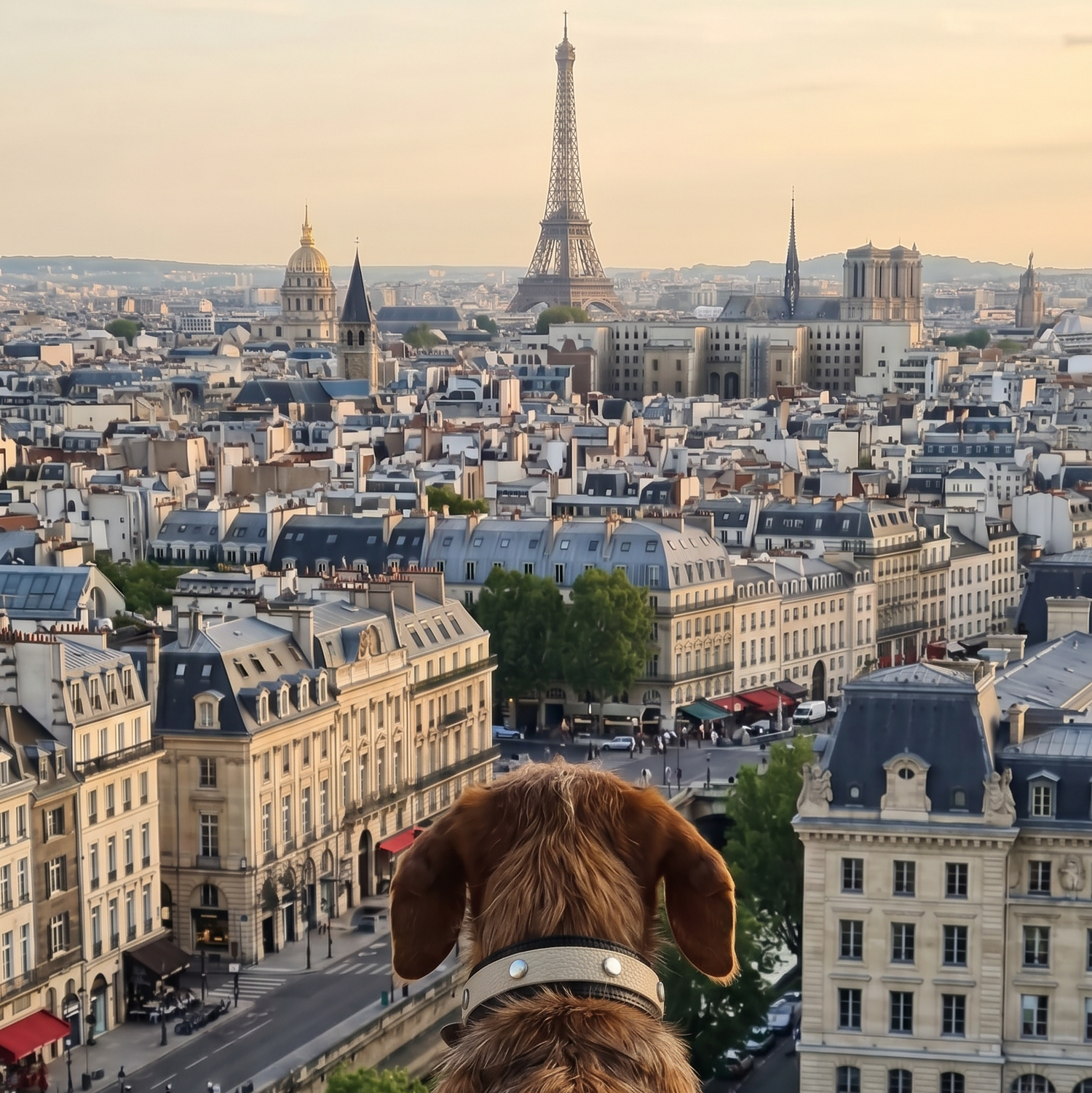
Paris unfolds its charms. It's the early strolls along the Seine, the first coffee at a still-quiet sidewalk table, and the little detours into those neighborhoods where everyday Paris begins. With a dog, this trip doesn't fundamentally change – but it does require a more conscious rhythm.
Because Paris is not universally dog-friendly. Many restaurants welcome well-behaved dogs without fuss, some luxury hotels offer thoughtful services, and even renowned department stores allow joint shopping. At the same time, museums, monuments, and numerous garden areas remain closed to dogs. Even in officially accessible parks, they are often only allowed to walk on leashes along the paths.
A successful vacation with a dog in Paris therefore arises not from a long list of sights, but from the right location, realistic daily stages, and consciously chosen places. This guide shows where Paris is particularly pleasant with a dog, which hotels communicate their pet policy transparently, and how you can explore the city without constantly overwhelming your dog with crowds, metro rides, and unsuitable activities.
Table of Contents
- Why Paris can be ideal for a vacation with a dog
- The best neighborhoods for a stay with a dog in Paris
- Dog-friendly hotels in Paris
- Walks and activities with a dog in Paris
- Restaurants, cafés, and wine experiences in Paris
- Travel planning, arrival, and best time to visit Paris
- A sensible itinerary for Paris with a dog
- Conclusion: Vacation with a dog in Paris
- Frequently asked questions
Key points at a glance
- Paris is more dog-friendly in everyday life than at sights: Restaurants, street cafés, boutiques, and some department stores usually work better than museums or monuments.
- Not every park is accessible: In 165 designated green areas, leashed dogs are allowed on the paths; lawns and flowerbeds are generally off-limits. Hotel location determines the daily rhythm: A hotel near Parc Monceau, the Seine, Parc de Bercy, or a designated green area is more practical than a hotel directly at a crowded attraction.
- Small dogs have an advantage on public transport: In a suitable bag or basket, they travel free of charge; larger dogs must be on a leash and wear a muzzle on the metro and RER. The most pleasant travel times are outside of midsummer: Spring and autumn combine milder temperatures with longer walks and more relaxed daily planning.
1. Why Paris can be ideal for a vacation with a dog
Paris is particularly suitable for people who do not see a city trip as a sequence of as many sights as possible. The city can be excellently experienced through individual neighborhoods: a morning stroll along the Seine, followed by breakfast in a café, later a visit to selected shops, and an afternoon break at the hotel. This calm, neighborhood-focused rhythm suits a dog much better than a classic sightseeing program.
The biggest structural advantage lies in the combination of short distances and high gastronomic density. In central neighborhoods, you don't constantly need to use the metro for a successful day. Le Marais, Saint-Germain-des-Prés, the 7th and 8th Arrondissements, or the area around Opéra can be explored on foot in sections. For a small dog, this means less crowding, fewer stairs, and fewer abrupt changes between noisy public transport and heavily visited places.
However, Paris is more regulated regarding its green spaces than, for example, Berlin, Vienna, or many British cities. Dogs are not automatically allowed in every park. The city currently designates 165 accessible green spaces; there, dogs must remain on a leash and may only use the paths. Additionally, there are 45 special dog areas and larger off-leash zones in the Bois de Boulogne and Bois de Vincennes. The Petite Ceinture, often recommended as a green walking path, is generally not open to dogs. Culturally, there is a clear distinction: Paris works excellently with a dog as a city for strolling, shopping, and dining – less so as a joint museum trip. Pets are not allowed in the Louvre and on the Eiffel Tower; recognized assistance dogs are an exception. Similar restrictions apply to most museums and monuments. What we would know beforehand: We would not book Paris based on its proximity to the Louvre or Eiffel Tower, but on the quality of the morning dog walk. A quiet path before breakfast has a greater impact on the entire trip than a view of a landmark.
PAWLII Tip:
- Ideal for small to medium-sized, city-experienced dogs
- Particularly suitable for relaxed travel, shopping, and gastronomy
- Less suitable for dogs that need a lot of off-leash exercise
- Museum visits must be organized separately
- Detailed park planning should be part of pre-trip preparation
2. The best neighborhoods for a vacation with a dog in Paris
Le Marais: the best mix of atmosphere and short distances
Le Marais, in the 3rd and 4th Arrondissements, is particularly versatile for a first vacation with a dog in Paris. The district combines historic streets, independent boutiques, cafés, and short distances to the Seine. In the morning, the area around Place des Vosges and Rue de Turenne is pleasantly quiet; from late morning, the narrow sidewalks become significantly more crowded, especially on weekends.
For dogs sensitive to crowds, the first walk should therefore take place before 9 AM. Later, the Seine is better than the heavily frequented shopping streets. Square Georges Cain also offers an officially accessible green area where leashed dogs are allowed on the paths. A special destination is Le Bone Appart on Rue de Birague. Opened in 2024, this concept combines a dog café, a small bakery, and a curated boutique. Snacks for humans and dogs are offered, as well as selected accessories. The visit can be well combined with a quiet morning in the southern Marais.
Opéra, Madeleine and the 8th Arrondissement: Luxury Travel with a Dog
The area between Opéra Garnier, Place de la Madeleine, Rue du Faubourg Saint-Honoré, and Parc Monceau is the best choice for travelers who want to combine luxury hotels, fashion houses, and classic Parisian architecture.
The wide boulevards are easier to navigate with a dog than the narrow streets of Le Marais. At the same time, traffic is much more present. A room located at the back is often more important here than a spectacular street view.
Parc Monceau has been partially open to leashed dogs since December 2025. Currently, they are allowed on the designated side paths; a temporarily established off-leash area was closed in spring 2026. For daily exercise, therefore, one should still plan with a leash.
Saint-Germain-des-Prés and the 7th Arrondissement: elegant, but not green everywhere
Saint-Germain and the adjacent 7th Arrondissement appear quieter and more residential in the early morning than many areas north of the Seine. The riverbanks, the Esplanade des Invalides, the Promenade Avenue de Breteuil, and the Champ-de-Mars offer suitable sections for leashed walks. Caution is needed in the Jardin du Luxembourg: dogs are not allowed in the entire garden, but only in a marked zone in the southeastern area between the corresponding entrances. There, they remain on a leash and are not allowed on lawns or flowerbeds. If you don't know this beforehand, you can quickly find yourself in front of a closed entrance and have to walk a larger loop. Canal Saint-Martin: relaxed everyday life instead of classic postcard scenery
Around the Canal Saint-Martin, you will find a younger culinary scene, smaller hotels, and a less formal daily rhythm. In the morning, it's pleasant to walk along the canal, but in the evening, the banks become lively. For noise-sensitive dogs, the hotel should not be directly at a popular meeting point.
Bercy and Bois de Vincennes: the best choice for more exercise
Those who want to allow their dog longer walks will find the most practical conditions in the 12th Arrondissement. Parts of Parc de Bercy are open to leashed dogs; since December 2025, the northern area has been one of the largest accessible green spaces in the city. In the Bois de Vincennes, there are also larger areas where dogs can run free. Disadvantage: You live less centrally and often need the metro or a taxi for classic destinations.
The neighborhoods compared:
- Le Marais: best overall mix for a first visit
- Opéra and 8th Arrondissement: ideal for luxury hotels and shopping
- Saint-Germain and 7th Arrondissement: elegant, but check park rules carefully
- Canal Saint-Martin: relaxed and gastronomically diverse
- Bercy and Vincennes: best option for active dogs
3. Dog-Friendly Hotels for a Vacation with a Dog in Paris
A hotel is not automatically truly dog-friendly just because pets are allowed in the room. For daily travel, four questions are particularly crucial: Is there a weight limit? How much is the fee? Is the dog allowed in the lounge, bar, or restaurant? And can it stay alone in the room during a short appointment?
Especially in Paris, the rules differ significantly. Some establishments welcome dogs without surcharge and without formal weight restrictions. Others only allow small dogs and exclude almost all dining areas. Therefore, this selection exclusively includes hotels whose pet policy can be verified through official sources.
| Name | Location | Style | Dogs allowed | Specific Pet Policy |
|---|---|---|---|---|
| Kimpton St Honoré Paris | Boulevard des Capucines, near Opéra Garnier | Modern five-star hotel with minimalist Art Deco influences | Yes, without published weight, size, or breed restrictions | According to the official IHG hotel website, pets are accepted free of charge. There is no published restriction regarding weight, breed, or number. The hotel's own FAQ adds as a practical limitation that the animal must fit in the elevators. Paid pet sitting and dog walking can be organized through the concierge. Whether dogs are allowed in the restaurant, rooftop bar, spa, or pool area is not clearly stated publicly and should be inquired about in writing before booking. |
| Le Grand Mazarin | Rue des Archives in Le Marais | Colorful, individual luxury boutique hotel | Yes, for dogs under 8 kg | Dogs weighing under eight kilograms are allowed. The fee is 35 Euros per dog per day. Pets are expressly not allowed in the pool area – even on a leash. The official terms do not clearly state whether dogs are allowed in the restaurant, bar, or unattended in the room. These points must be confirmed directly. |
| Le Meurice | Rue de Rivoli opposite the Jardin des Tuileries | Historic Parisian Palace Hotel with art-oriented interior | Yes, no published weight limit | The fee is 40 Euros per animal per day. A dog bed, bowl, and toy are provided in the room. In all public areas, dogs must be on a leash or carried in a bag or basket. They are allowed in Restaurant Le Dalí and La Galerie; larger dogs must stay at the foot of the table. They are not permitted in Bar 228, the spa, or during dinner service in the restaurant Le Meurice Alain Ducasse. The dog must be registered at the time of reservation. The hotel does not publish a maximum number or rules regarding leaving the dog alone in the room. |
| Hôtel de Crillon, A Rosewood Hotel | Place de la Concorde | Monumental Palace Hotel with elegant, residential Rosewood style | Yes, up to 10 kg maximum | The Hôtel de Crillon accepts pets up to ten kilograms. The fee is 150 Euros per stay, not per night. According to the official hotel policy, they are generally allowed in the hotel areas; excluded is the Sense, A Rosewood Spa. For the Bar Les Ambassadeurs, the hotel explicitly confirms dogs up to ten kilograms. The maximum allowed number, in-room amenities, and rules for unsupervised stays are not published. |
| Le Bristol Paris | Rue du Faubourg Saint-Honoré, 8th Arrondissement | Classic Parisian Palace Hotel with an inner courtyard garden | Yes, regularly up to 7 kg | The hotel states a regular weight limit of seven kilograms and charges 100 Euros per day. A special welcome kit for the pet is included. Le Bristol states on its official FAQ page that it may be flexible regarding the weight limit for well-behaved animals. However, this is not a guarantee and must be confirmed before booking. The publicly available policy does not specify binding rules for restaurants, bar, garden, spa, or leaving the dog alone in the room. |
How dog-friendly are these hotels really?
For an uncomplicated stay, the Kimpton offers the most liberal policy. This is particularly relevant if your dog weighs more than seven or ten kilograms or if you bring a second dog.
Le Meurice and Hôtel de Crillon offer a better solution if you want to have your dog with you in certain hotel areas during a drink or meal. At Le Bristol and Plaza Athénée, you should carefully consider how you will organize breakfast and dinner. A hotel can be very attentive in the room while simultaneously excluding important dining areas.
Also pay attention to the room location. In Paris, courtyards are not automatically quiet, and rooms on large boulevards can be strenuous for noise-sensitive dogs despite high-quality windows. Ask for a quiet room, preferably far from the elevator, housekeeping station, and event floor.
Clarify before booking:
- Does the weight limit include the transport bag?
- Can the dog stay alone in the room?
- Is it allowed at breakfast or only in a separate lounge?
- Are there restrictions for the courtyard, bar, and restaurant?
- Which green space is actually within walking distance in the morning?
4. Walks and activities on vacation with a dog in Paris
Our experience with Paris can be summarized as follows: In many designated parks, walks with a leashed dog are uncomplicated – but you should never assume that every garden is open. The signage at the entrance is binding. In accessible areas, dogs must stay on the paths; lawns, flowerbeds, and playgrounds are generally excluded. A quiet morning walk in Le Marais
Start between 7:30 and 8:30 AM near Place des Vosges. Walk through the still-quiet streets towards the Seine and then along Quai des Célestins or Quai Henri IV. At this time, delivery traffic and commuters are already on their way, but the narrow sidewalks are not yet filled with groups of visitors.
For a short green break, Square Georges Cain is suitable. Afterward, Le Bone Appart can be planned as a later stop. The paths are generally not long; precisely this makes the route pleasant for smaller dogs.
From the 8th Arrondissement to Parc Monceau
From Faubourg Saint-Honoré, an urban loop leads through quieter side streets to Parc Monceau. Don't plan for off-leash running: the side paths are open to leashed dogs, but the separate off-leash regulation may be suspended. Afterward, a break at the hotel or café is recommended before the surroundings become busier in the afternoon. The Seine, Cours Albert 1er, and Jardins des Champs-Élysées
For guests in the 7th or 8th Arrondissement, a loop from the Seine via the Promenade du Cours Albert 1er and the Jardins des Champs-Élysées is ideal. Both areas allow leashed dogs on the paths. The route is central, relatively flat, and can be easily shortened. Organize sights realistically
Dogs are not allowed in the Louvre or on the Eiffel Tower, regardless of whether they are carried in a bag; recognized assistance dogs are an exception. Instead of leaving the dog in the hotel room during a long museum visit, cultural activities should be split: one person visits the museum while the other takes the dog for a walk, or you book a reputable dog sitter through the hotel. Department stores as weather-independent alternatives
Famous Parisian department stores can be a good activity for rainy or very hot hours with a small dog. Le Bon Marché expressly allows pets, provided they are on a leash. The adjoining Grande Épicerie is excluded for hygiene reasons. Galeries Lafayette currently reports that small dogs up to seven kilograms are allowed in the Coupole and Homme sections, but not in the gourmet and food areas. Since this regulation is not communicated with equal transparency on all official websites, it should be confirmed again at the respective entrance.
Tips for a successful daily routine:
- Plan walks as early as possible before 9 AM and after rush hour
- Always check park access at the signage
- Do not plan museums as a shared program item
- Visit department stores only outside of food areas
- After two to three urban hours, take a real break
5. Restaurants, Cafés, and Wine Experiences with Dogs in Paris
Paris appears very dog-friendly gastronomically, as you regularly see dogs under bistro tables. However, there is no general legal right to entry. The respective restaurateur decides whether animals are accepted in the dining area. They may require the dog to remain on a leash; production, storage, and other sensitive food areas are excluded. Recognized assistance dogs are subject to different legal regulations. In practice, street cafés and traditional brasseries are the most straightforward. Do not just reserve a table, but mention the dog. The phrase "un petit chien calme" (a small calm dog) facilitates categorization but does not override weight or house rules. A table at the edge is better than a spot in the middle of the service path.
French restaurant culture expects a dog to remain quietly under or next to the table. It should not be placed on a bench or a restaurant chair. A small travel blanket creates a clear resting place and prevents the dog from constantly searching for a suitable position in confined spaces.
Some hotel restaurants offer a more reliable option. At Le Meurice, dogs are allowed in Le Dalí and La Galerie under certain conditions. Hôtel de Crillon welcomes small dogs in Bar Les Ambassadeurs, while Plaza Athénée opens La Galerie but excludes other dining areas. What about wineries?
Paris is not a classic winery destination. If you want to combine wine and dog, a quiet wine bar, a private tasting, or an individually organized excursion is better advised than a regular cellar tour. In Champagne, the rules vary from house to house; dogs are often not accepted in production and cellar areas. Specialized providers like Joon Dog Tours arrange individual dog-friendly excursions, but access must still be confirmed separately with each winery.
Restaurant etiquette with a dog:
- Announce the dog already when making the reservation
- Request a table by the edge or on the terrace
- Bring your own blanket and water
- No feeding from the table
- For close dinner service, prefer the hotel bar or an early dinner
6. Travel Planning for a Vacation with a Dog in Paris
Traveling by Train
For travelers from Germany, the train is often the most pleasant solution. The fastest direct connections between Frankfurt and Paris take approximately three hours and 40 minutes according to Deutsche Bahn; several direct trains are offered per day depending on the timetable. Connections and construction sites can change, so the specific journey should be checked before booking. Pets generally travel free of charge with Deutsche Bahn in a suitable transport box. For larger dogs on international connections, half the adult fare is usually charged; they must be on a leash and wear a muzzle. For cross-border trains, the conditions of the respective operator may also be relevant. The advantage over flying is not only the travel time from city center to city center. You can offer water, observe the dog, and better control the process. Book a direct connection if possible and avoid a seat directly next to doors or the onboard bistro.
Public Transport in Paris
Small dogs can travel free of charge on the Metro, RER, and other public transport if they are transported in a suitable closed container. Larger dogs are allowed on the Metro and RER networks on a leash and with a muzzle; stricter restrictions apply to other modes of transport. For a small dog, a light, well-ventilated travel bag is therefore not only practical for the journey. It also protects them on crowded platforms and long escalators. If possible, avoid rush hour between approximately 8 and 9:30 AM and 5 and 7 PM.
Entry Requirements
For travel between EU member states, dogs require an EU pet passport, a valid rabies vaccination, and a microchip. The identification number in the passport must match the chip. Also, check the waiting period after a first rabies vaccination before departure. Best Travel Time
For long city tours, April to mid-June and September and October are best. Spring is usually mild, while autumn is more changeable but often pleasant for walks. Summer can be hot; asphalt, long paths without shade, and heated hotel rooms must then be taken seriously. The city of Paris recommends early or late walks, sufficient water, and particular caution on hot surfaces during heatwaves. Typical Planning Errors
The most common mistake is too full a schedule. Three quarters, a museum, and dinner in one day may be feasible without a dog. With a dog, however, there will be waiting times, drink breaks, and spontaneous detours because a park entrance is not accessible.
Better planning:
- Only one main district per day
- Direct train connection instead of unnecessary transfers
- Hotel near a reliably accessible green space
- Organize museum visits with childcare solution in advance
- Confirm air-conditioned room in writing for summer
7. Itinerary: Four Days Vacation with a Dog in Paris
A classic road trip is neither necessary nor sensible within Paris. Parking spaces are scarce, traffic is dense, and many hotel garages work with external parking services. A four-day itinerary with a clear spatial focus each day works better.
Day 1: Arrive and Understand Your Neighborhood
Don't plan a big program after the train ride. Check into the hotel, show your dog its resting place, and then just take a short walk. In the Marais, this leads to the Seine, in the 8th arrondissement to the Cours Albert 1er or towards Parc Monceau.
The first dinner should take place at the hotel or in the immediate vicinity. This way, you can cut it short at any time if your dog is restless after the journey.
Day 2: Le Marais, Seine and Le Bone Appart
Start early at Place des Vosges and walk through the southern part of the Marais. Take a longer break before the streets get crowded. Later, visit Le Bone Appart on Rue de Birague and selected boutiques. The afternoon is deliberately left free. A dog constantly processes smells, traffic, people, and noises in a city. Two quiet hours in the hotel are not a lost vacation day, but the basis for a relaxed evening.
Day 3: Saint-Germain and Le Bon Marché
Travel to Saint-Germain outside of rush hour. Take a walk along the Seine or through the accessible zone of the Jardin du Luxembourg. Note that dogs are only allowed to use the garden via the designated entrances and paths. Afterwards, Le Bon Marché is suitable for a joint shopping trip. Take turns visiting the Grande Épicerie, as pets are not allowed there. Day 4: Bercy or Bois de Vincennes
After three urban days, the dog should have more space. Parc de Bercy offers a more central, leashed walk. For longer walks and designated off-leash areas, continue to the Bois de Vincennes. Return to the hotel in the afternoon and end the trip with an early dinner or drink in a dog-friendly hotel area.
Why this itinerary works:
- short first leg after arrival
- central districts on separate days
- indoor shopping as a weather-independent program item
- longer nature day after several hours in the city
- sufficient rest before the return journey
8. Conclusion: Is a vacation with a dog in Paris worthwhile?
A vacation with a dog in Paris is particularly worthwhile for travelers who do not want to experience the city exclusively through its most famous sights. The real quality lies in the districts: in the quiet Marais in the morning, during a break on the Seine, in a carefully chosen café, and in those hotels that not only tolerate the dog in the room but integrate its presence into the entire stay.
Paris, however, requires more preparation than a decidedly green destination. Not every park is accessible, off-leash opportunities are often outside the classic city center, and museums or monuments cannot be visited together. Those who ignore these restrictions will spend a lot of time on detours and spontaneous replanning.
With a good hotel base, one district per day, and consciously planned rest periods, Paris becomes very pleasant. Small, city-experienced dogs benefit from short distances, the high density of cafés, and the relatively uncomplicated options in selected shops and department stores.
We would not plan a trip to Paris with a dog for a long list of sights. We would understand the city as a combination of walks, design, gastronomy, and time spent together. This is precisely where its strength lies: Paris with a dog does not have to be experienced faster or more completely. It can be more selective - and often more personal as a result.
Our final recommendation:
- Choose the hotel based on the dog's walking routine, not just the address.
- Focus on one district per day.
- Reserve restaurants with explicit mention of the dog.
- Check park rules before each longer route.
- Give rest periods the same importance as sightseeing.