
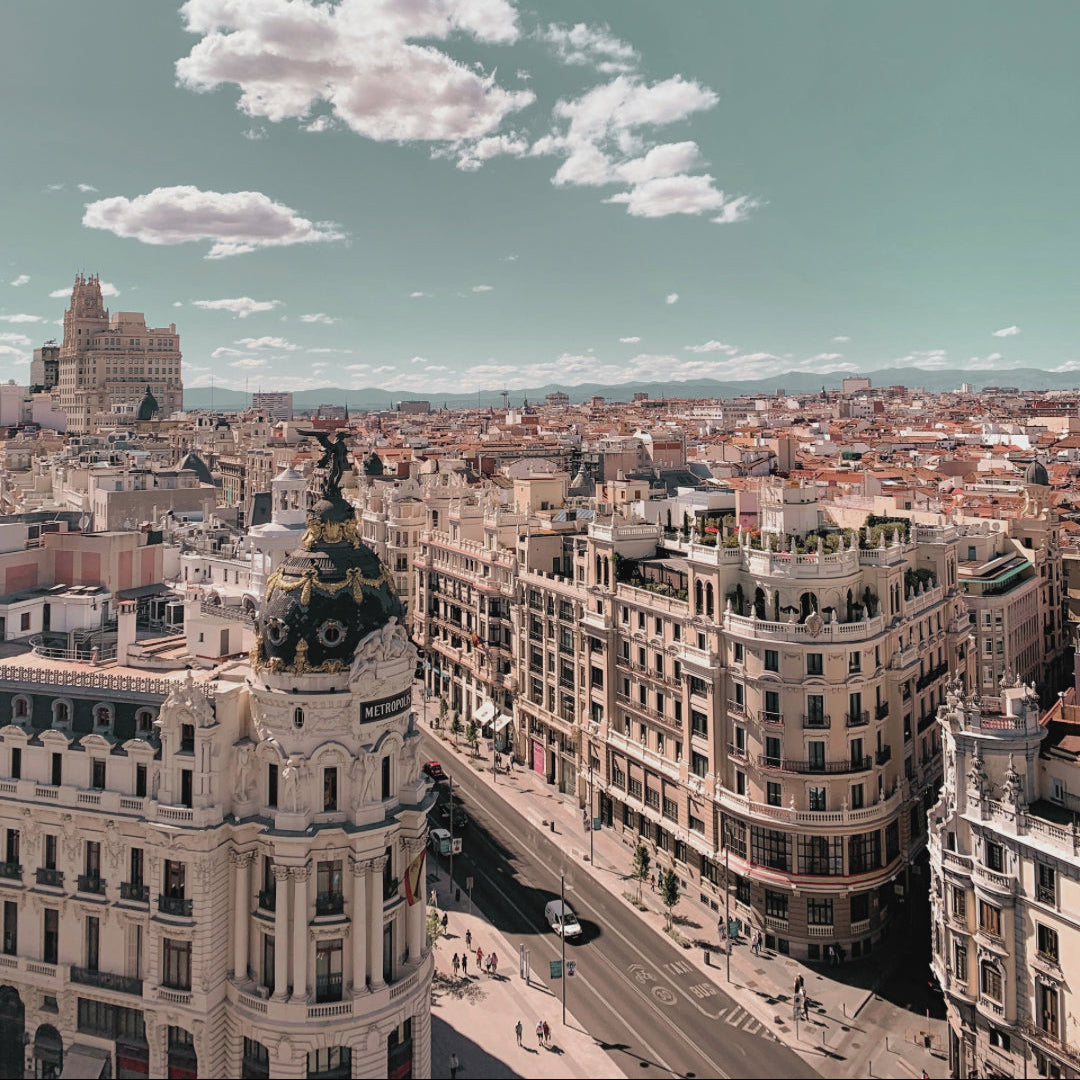
Madrid is not a city you can simply "take along" with your dog. It demands a different rhythm: head out early, consciously take it easy during the warm hours, and then venture out again in the evening when the streets cool down and life unfolds on terraces, in parks, and on the wide sidewalks.
But this is precisely where its charm lies. Madrid is not a classic "dogs allowed everywhere" travel destination. Museums, many historical interiors, and some restaurants remain reserved for humans. However, the city offers something that is often more valuable when traveling with a dog: spacious parks, neighborhoods with real everyday life, many terraces, and a culture that doesn't just happen behind closed doors.
With the right hotel choice, realistic daily planning, and an eye for quieter moments, Madrid becomes a very special city trip with your dog. Not because you check off as many sights as possible, but because you're out in the Retiro in the morning, consciously taking a break at lunchtime, and strolling through the Barrio de las Letras or Salamanca together in the evening.
This guide will show you which neighborhoods are suitable for a dog-friendly vacation in Madrid, which hotels truly communicate their rules transparently, where walks work best, and how to plan your Madrid trip so that your dog isn't just present, but can enjoy the journey with you.
Table of Contents
- Why Madrid works for a dog-friendly vacation – and where the city has its limits
- The best neighborhoods for a dog-friendly vacation in Madrid
- Dog-friendly hotels in Madrid: What the pet policies really mean
- Walks and activities with your dog in Madrid
- Restaurants, cafes, and wineries with your dog in Madrid
- Trip planning for a dog-friendly vacation in Madrid
- Road trip and itinerary: Madrid, El Escorial, and Sierra de Guadarrama
- Conclusion: A dog-friendly vacation in Madrid
- Frequently asked questions
Key points at a glance
- Madrid is particularly suitable for small to medium-sized, city-savvy dogs, provided you plan your days around cool mornings, quiet middays, and long evenings.
- The best time to visit Madrid with your dog is spring and early autumn. In summer, you should consistently avoid hot pavements and midday hours.
- Dogs are allowed in many parks in Madrid. However, outside designated off-leash areas, rules apply: in summer, dogs are only allowed off-leash in many parks between 8 PM and 10 AM, and in winter between 7 PM and 10 AM.
- The subway can be used with a dog, but only on a leash and with a muzzle, in the last car, and not during weekday rush hours.
- The Perrisimo Dog Café near the Retiro is one of the most reliable places for a joint break, as it offers a special menu for both dogs and humans.
1. Why Madrid works for a dog-friendly vacation – and where the city has its limits
Madrid is not a city that aggressively markets its dog-friendliness. It seems more like a metropolis where dogs are increasingly taken for granted – as long as they are well-behaved, move safely in crowded situations, and can share space with other guests. This is precisely what differentiates Madrid from some coastal towns in Spain or cities like Copenhagen, Amsterdam, or Berlin: the possibilities are there, but they must be consciously utilized.
Madrid's biggest advantage lies in its combination of urban life and generous green spaces. The Retiro, Madrid Río, and Casa de Campo provide a balance to the narrow streets of the old town and the dense center around Sol or Gran Vía. If you stay centrally, you can go for a long walk in the park in the morning, have breakfast afterwards, return to the hotel at lunchtime, and only head back into the city in the evening. This is not a compromise, but the best way to experience Madrid with a dog.
Another advantage is the strong terrace culture. Madrid lives outdoors – for breakfast, aperitivo, and late dinner. This makes traveling with a dog much easier because you don't constantly have to search for indoor spaces where animals are allowed. Nevertheless, not every terrace is automatically dog-friendly, and in indoor spaces, establishments decide for themselves whether to allow dogs. The official tourism organization of Madrid therefore explicitly recommends asking about the respective rules before entering a cafe, restaurant, or shop.
The biggest limitation remains the heat. Madrid is located inland, summer months are dry and warm, and the city noticeably retains heat. Asphalt, little wind in narrow streets, and crowded squares can become exhausting for dogs faster than the outside temperature might suggest. A dog that can easily walk through a city for several hours at home might need shade, water, and a break in Madrid in July after a short time.
Madrid is therefore particularly well-suited for dogs that feel secure in urban situations: traffic, elevators, hotel lobbies, terraces, rolling suitcases, and changing noise levels are part of everyday life. For very noise-sensitive dogs, dogs with circulatory problems, or young dogs without city experience, midsummer is not a good time to travel.
Madrid with a dog works particularly well if you:
- stay centrally and can walk many distances,
- plan lunchtime as a conscious rest period at the hotel,
- have a calm, well-behaved, and city-savvy dog,
- use parks as a regular part of the day, instead of just for quick potty breaks,
- choose fewer activities and allow more time for shared routines.
2. The best neighborhoods for a dog-friendly vacation in Madrid
For a dog-friendly vacation in Madrid, it's not crucial to stay as close as possible to every sight. Much more important is how quickly you can take a good first walk in the morning, whether you can return to the hotel at lunchtime without long distances, and how quiet the surroundings become in the evening. The right location changes the entire itinerary.
Retiro and Salamanca: The most elegant base for quiet routines
The area around the Retiro and the Barrio de Salamanca is the most harmonious choice for many trips with a dog. The Retiro is centrally located and offers wide paths, shady areas, designated dog zones, and enough space for a longer morning walk. Especially before nine o'clock, the park feels significantly quieter than at lunchtime. Then you are more likely to encounter joggers, people with their dogs, and residents than tour groups or school classes.
For the first walk, it's worth not going directly to the large lake or the most famous photo spots. The smaller paths on the edge of the park seem quieter, give your dog more opportunity to sniff around, and avoid unnecessary stimuli. In Madrid, the quality of a walk does not depend on how many sights are along the route. It arises from peace, shade, and a pace that works for your dog.
Salamanca itself is more orderly, quieter, and less touristy than many neighborhoods in the immediate center. The streets are wider, the selection of high-quality hotels and cafes is larger, and you don't have to walk back to the hotel through the dense crowds around Sol after dinner. For small dogs, who have to process many stimuli faster, this is a clear advantage.
Barrio de las Letras and Cortes: Central, lively and easily walkable
The Barrio de las Letras is particularly suitable for travelers who want to experience Madrid through its atmosphere. Literary history, small squares, historic facades, restaurants, and paths towards the Prado, Retiro, and Atocha are all close together. With a dog, the neighborhood is especially pleasant in the morning and late in the evening. During the day, individual streets can become crowded; for relaxed walks, you should therefore choose side streets and not exclusively follow the main tourist routes.
The strength of this neighborhood is its proximity. You can walk towards the Retiro in the morning, have breakfast in a cafe afterwards, and quickly return to the hotel at lunchtime. For a short city trip of three or four nights, this is logistically much easier than a hotel in a more outlying neighborhood.
However, the Barrio de las Letras is not a quiet residential area. Especially on weekends and warm evenings, it can get lively. For a dog that reacts quickly to voices, music, or many people, a hotel room facing the inner courtyard or in a quieter side street is advisable.
Chamberí: Quieter living, more local dining
Chamberí is the right choice if you want to not just see Madrid, but inhabit it for a few days. The neighborhood feels less touristy, has classic residential streets, smaller squares, and a quieter daily dynamic. Especially for dogs who shouldn't walk through a very lively center at night, Chamberí can be a good alternative.
However, a hotel in Chamberí means you have to plan your routes more consciously. For Retiro, Prado, or the Barrio de las Letras, depending on the location, you will need a metro ride, a taxi, or a longer walk. In return, you get a more authentic neighborhood atmosphere in the mornings and evenings, where your dog doesn't constantly have to navigate between tour groups, rolling suitcases, and restaurant queues.
Madrid Río and Casa de Campo: The green counter-movement to the city center
Madrid Río is not a classic sight, but a very practical answer to the question of how a dog gets enough exercise in a big city. Along the Manzanares, wide paths, bridges, green spaces and seating areas connect. For an early or late walk, the area is much more suitable than the narrow streets in the center.
This contrast becomes even stronger in the Casa de Campo. The large park is ideal if your dog needs a quieter balance after two days in the city center. Plan water, a clear route and enough time. The Casa de Campo is not a manicured city garden with short paths, but a much more natural area. In summer, paths can be dry, dusty and warm; in the early morning hours or late afternoon, the atmosphere is much more pleasant.
The best location for your dog-friendly vacation in Madrid depends on what is important to you:
- Retiro and Salamanca: the best mix of proximity to the park, elegant hotels, and a quiet daily routine.
- Barrio de las Letras and Cortes: ideal for a short, central city trip with many walkable distances.
- Chamberí: suitable for longer stays and dogs that need more peace and quiet in the evening.
- Madrid Río and Casa de Campo: important for exercise, nature, and quieter hours.
3. Dog-friendly hotels in Madrid: What the pet policies really mean
In Madrid, "pet friendly" does not automatically mean that your dog is welcome everywhere in the hotel. The differences between establishments are significant. Some hotels allow dogs in large parts of the building, while others restrict them to certain rooms or expressly forbid leaving the dog alone in the room.
Especially on a luxury trip, you shouldn't just filter by "dogs allowed." The details are crucial: Is there a weight limit? How much is the fee? Is your dog allowed at breakfast? Is the lobby accessible? Can the dog stay alone in the room during a short spa appointment? And how far away is the nearest park really?
The following selection deliberately focuses on establishments whose pet policy is currently publicly verifiable. Where rules regarding restaurants, lobbies, or leaving pets unattended are not explicitly published, specific usage should be confirmed in writing before booking.
| Hotel | Location & Style | Dogs Allowed | Fees & Limits | What the policy specifically means |
|---|---|---|---|---|
| Rosewood Villa Magna | Salamanca, on Paseo de la Castellana. International luxury hotel with a quiet, elegant city hotel atmosphere. | Small and medium-sized dogs and cats allowed. | Up to 15 kg; maximum two pets per room; €150 per pet per stay. | Particularly transparent policy: Dogs are allowed on a leash in large parts of the hotel. Sense Spa and fitness area are excluded. Outside the room, your dog must be on a leash or in a carrier. Upon arrival, a pet policy agreement is required. |
| Thompson Madrid | Central on Plaza del Carmen, near Gran Vía and Sol. Modern, urban lifestyle hotel. | Dogs and cats allowed. | One pet per room; maximum 10 kg; €50 per night. | The most important restriction: pets are not allowed to be left unattended in the room. Dogs are also not allowed in the hotel bar or restaurants. This hotel is only suitable if your dog can truly be with you constantly and you plan restaurant outings outside the hotel. Proof of current liability insurance is required at check-in. |
| Hyatt Regency Hesperia Madrid | Paseo de la Castellana. Spacious, classic city hotel with an international service standard. | Dogs and cats allowed. | Up to two pets per room; according to official policy up to 40 kg; €20 per pet per night. | The hotel provides beds as well as food and water bowls upon request. Pets are only allowed in certain room categories, so a pet-friendly room must be confirmed in advance. The official policy does not publish a binding statement on access to restaurant or breakfast areas; please inquire about this in writing before booking. |
| NH Collection Madrid Palacio de Tepa | Barrio de las Letras. Historic boutique hotel in a 19th-century palace. | Dogs and cats allowed. | Up to 25 kg; maximum two pets per room; €35 per pet per night. | The number of pet-friendly rooms is limited. Therefore, bringing your pet must be confirmed in advance. The hotel policy does not publish a clear rule regarding lobby, breakfast area, or restaurant access. For travelers with dogs, this hotel is particularly attractive due to its central location and short distances to the Retiro. |
| NH Collection Madrid Colón | Salamanca, near Plaza de Colón and Retiro. Classic city hotel with modernized interiors. | Dogs and cats allowed. | Up to 25 kg; maximum two pets per room; €35 per pet per night. | Here too, limited availability of pet-friendly rooms, so book in advance. The location is particularly good if you want to quickly reach the Retiro in the morning and don't want to walk back through the busy center after dinner. You should inquire directly with the hotel beforehand about access to dining and pool areas. |
For small dogs that sleep with you in the room and remain calm in public areas, the Rosewood Villa Magna is the clearest luxury option. The policy is transparent, the dog is allowed to move around the hotel on a leash, and the location in Salamanca works very well for a quiet travel routine.
The Thompson Madrid is visually and location-wise attractive, but not suitable for every dog trip. The rule that animals can never be left alone in the room changes the entire daily schedule. Anyone planning museums, long lunches, or dinners without their dog will quickly run into limitations with this policy.
The two NH Collection properties are less exclusive than Rosewood, but often more pragmatic for a stylish city trip. The weight limit of up to 25 kilograms and the central location make them particularly interesting for travelers with a medium-sized dog.
Here's what you should always look out for when choosing dog-friendly hotels in Madrid:
- Is your dog allowed in the breakfast area or only on the terrace?
- Can he be left alone in the room for a short time?
- Are there weight limits, fees, or a maximum number of pets per room?
- Do you have direct access to a suitable morning walk?
- Is the room air-conditioned and quiet enough for a midday rest?
4. Walks and activities with your dog in Madrid
Madrid rewards travelers who view walks not as gaps between sights, but as a central part of the day. The best moments often happen before nine in the morning. The air is cooler, the streets are quieter, and even well-known places feel less like a backdrop for visitors and more like a city where people live their daily lives.
Retiro in the morning: The classic start to the day
Retiro should not be a quick checkbox item. Plan it as a morning routine. Start at the edge of the park, first walk on smaller paths, and deliberately visit the well-known areas around the large lake later. Especially in the morning, the atmosphere is calmer, and your dog can orient itself better.
In many Madrid parks, dogs are allowed to run off-leash during certain time slots. In summer, this is usually from 8 PM to 10 AM, and in winter from 7 PM to 10 AM. Playgrounds, areas for the elderly, and areas where dogs are explicitly prohibited are excluded. Outside these times, dogs must be kept on a leash.
This sounds straightforward, but in practice, it requires caution. An unleashed dog encountering joggers, scooters, pigeons, or other dogs in an unfamiliar city should be reliably recallable. For many travelers, a longer training leash is a more reliable solution. It gives the dog space to sniff and you the security of being able to intervene at any time.
Madrid Río: Exercise without city center stress
Madrid Río is ideal if your dog needs a bit more distance in the morning. The paths along the river are wider than in the center, the sightlines are more open, and the atmosphere is less dense. Especially after a day around Gran Vía, Sol, or Prado, this walk feels like a reset.
You can flexibly shorten the route, turn back at a bridge, or take a water break on a bench. For small dogs, it's not worth trying to cover as many kilometers as possible. In Madrid, it's not just the distance that's strenuous, but the combination of heat, ground, noise, and many impressions. Better 45 quiet minutes by the river than two hours through the hot city center.
Casa de Campo: The day Madrid becomes landscape again
Casa de Campo is the best place if your dog needs a real break from the urban rhythm. The park is significantly larger and more natural than Retiro. This means more space, more paths, but also more planning. Bring water, choose a manageable route, and avoid the warm hours of the day.
For small dogs or dogs that don't tolerate heat well, Casa de Campo is especially suitable in spring, autumn, or early morning. In midsummer, even a shadier natural path can quickly become too warm. Pay attention not only to the temperature but also to the ground. Dry, dusty paths and hot surfaces are more strenuous for paws than many people expect.
A realistic daily routine with a dog in Madrid
A successful day in Madrid rarely involves going from museum to museum and somehow organizing the dog in between. A clear rhythm works better: a longer walk in the morning, a relaxed breakfast, a real rest period at the hotel, and a second active phase from late afternoon.
Madrid's official tourism organization explicitly recommends early morning or late evening walks for dogs, sufficient water, and breaks in the shade.
The best walking and activity principles for Madrid:
- Start the first longer walk before breakfast.
- Use Retiro for park atmosphere, Madrid Río for exercise, and Casa de Campo for a break from the city center.
- On warm days, plan a proper midday rest at the hotel.
- In busy parks, prefer a leash or long training leash over spontaneous off-leash running.
- Always bring water, a foldable bowl, and a small mat for terrace breaks.
5. Restaurants, cafes, and wineries with dogs in Madrid
Madrid is a city of long evenings. This generally fits well with traveling with a dog, because the temperatures become more pleasant in the evening and life shifts outdoors. At the same time, you shouldn't assume that every dog is automatically allowed in every restaurant. In Spain, establishments often decide for themselves whether dogs are welcome indoors. Terraces are usually the better option, but also no guarantee.
Therefore, the most reliable approach is: check beforehand, make a reservation, and honestly state the dog's size and temperament. A dog that can lie quietly under the table will almost always be more relaxed on a terrace than a dog that constantly moves between tables, chairs, and service paths.
Perrisimo Dog Café: An address that considers both guests
The Perrisimo Dog Café near Retiro is more than a nice exception. It is one of the few places in Madrid whose concept is clearly tailored to the joint visit of humans and dogs. The café offers specialty coffee and brunch for humans, as well as its own menu for dogs with small dishes, pupcakes, and dognuts (with healthy ingredients). Perrisimo explicitly describes itself as a café directly by Retiro, where dogs are not just tolerated, but are part of the idea.
Especially after a morning walk in Retiro, Perrisimo works very well. Your dog has already exercised, is not overexcited, and can relax better under the table. After the extended walk, the dog immediately finds everything for its well-being and, of course, always fresh water. Take a shared break!
Restaurants: Terrace beats improvisation
For lunch and dinner, outdoor terraces are the best basis. Don't plan with a list of restaurants that were once online as pet-friendly years ago. Opening hours, change of ownership, and rules can change. It is better to choose your desired area and ask the restaurant directly: "¿Aceptáis perros en la terraza?" – "Do you accept dogs on the terrace?"
For dogs that quickly become restless at the table, a late dinner is often more pleasant than a long lunch. The streets are cooler, the dog is more relaxed after the evening walk, and the terrace becomes less of a test of patience. Bring a small blanket, water, and a quiet chew toy. This is not a luxury detail, but it makes the entire evening easier.
Wineries in the surrounding area: Plan only with prior confirmation
The area surrounding Madrid can be a nice addition to a city trip. However, many bodegas and smaller wineries do not publish a clear, current pet policy. Therefore, you should never blindly book a wine tasting with a dog as a fixed program item.
Often, a stay on the terrace or a walk in the vineyards is possible, while cellars, production areas, or tasting rooms are not accessible. Therefore, ask specifically in advance: Is the dog allowed on the outdoor premises? Can it join the tasting? Is there shade and water? If you do not receive a clear commitment, only plan the bodega as an option or split the appointment so that one person stays with the dog.
How to better enjoy moments with your dog in Madrid:
- Preferably reserve a terrace seat at the edge.
- Inquire in advance about indoor areas, terraces, and potential size restrictions.
- Plan Perrisimo as a safe, shared café stop near Retiro.
- In the summer months, choose a late dinner rather than a long lunch.
- Book wineries only with written confirmation that dogs are allowed.
6. Travel planning for a holiday with a dog in Madrid
Travel planning for Madrid doesn't start with a list of sights, but with three practical questions: How does your dog get to the city relaxed? Where can it relieve itself on the first evening? And how do you avoid the arrival day already bringing too many impressions?
For entry from Germany to Spain, your dog generally needs a microchip, a valid rabies vaccination, and an EU pet passport. The Spanish agricultural authority explicitly states these requirements for entry with a dog, cat, or ferret from an EU country. Before departure, also check whether all information in the passport is legible and up-to-date.
Arrival: Flight, car or train?
For small dogs, flying is usually the fastest option. However, what matters is not just the pure flight time, but the entire travel chain: journey to the airport, security control, waiting time, flight, baggage claim, and transfer to the hotel. Therefore, do not plan a restaurant reservation, a long walk through the city center, or a fixed sightseeing appointment on the day of arrival.
An early check-in or a hotel with luggage storage and proximity to a park is more valuable than a cheap flight with a late arrival. Especially after a flight, your dog first needs to orient itself: a quiet room, water, a short walk, and time to perceive the new environment.
Traveling to Madrid by car is primarily sensible if the city is part of a longer trip to Spain. For a pure short trip from Germany, the journey is long and brings additional stress due to kilometers, heat, and parking search. However, if you want to combine Madrid with Castile, the Sierra de Guadarrama, or northern Spain, you can be very flexible with a rental car from Madrid.
Public transport with a dog
The metro can be used with a dog, but it is not entirely straightforward. One dog is allowed per passenger. The dog must be leashed, wear a muzzle, and travel in the last car. During weekday peak hours, dogs are not allowed.
For small dogs, a carrier bag can still be more comfortable, especially in crowded stations or longer walks through stations. It reduces stress, protects the dog from crowds, and makes boarding easier. In EMT city buses, small pets are only allowed in a suitable carrier box; larger dogs are generally not allowed, with the exception of assistance dogs.
Best time to visit Madrid with your dog
March to May and mid-September to November are the most pleasant months for Madrid with a dog. Long walks are more realistic, parks are more attractive, and the city can be enjoyed better during the day.
In summer, Madrid can work, but only with a clear rhythm: get up early, stay indoors at midday, and go out again in the evening. Plan for an air-conditioned hotel, a park within walking distance, and flexible restaurant hours. The most common planning mistake is to treat Madrid like a classic cultural trip. Museums, churches, and many interiors are not places where your dog can accompany you. Rather, choose a few targeted cultural dates and build the rest of the trip around shared walks, cafes, and quiet evenings.
What you should know before you go
Madrid doesn't get worse if you tick off fewer things. On the contrary: the city gains when you walk through Retiro in the morning, consciously take a break at midday, and sit on a terrace with your dog in the evening, instead of trying to squeeze ten sights into 48 hours.
Your planning checklist for Madrid with a dog:
- Check EU pet passport, microchip, and valid rabies vaccination.
- Ask the hotel in writing about restaurant, lobby, and leaving-alone rules.
- Pack a well-fitting muzzle for the metro.
- Bring a lightweight carrier bag or comfortable carrier for rest periods and public transport.
- In midsummer, only plan with a very early and very late daily program.
7. Road trip and itinerary: Madrid, El Escorial and Sierra de Guadarrama
The best trip through Madrid with a dog is not a route that requires a new hotel every day. Constant checking in and out, long car journeys, and parking searches drain energy – both yours and your dog's. It makes more sense to have a fixed base in Madrid and a deliberate excursion into the surrounding area if the city becomes a bit too dense after two or three days.
Day 1: Arrive, settle in, Retiro in the evening
On arrival day, only plan for hotel check-in, a first quiet walk, and a late dinner on a terrace. Choose a hotel near Retiro, Salamanca, or Barrio de las Letras. The first walk doesn't have to be spectacular. Your dog needs time to take in smells, orient itself, and understand that this hotel will be its resting place for a few nights.
Day 2: Retiro, Perrisimo and Barrio de las Letras
Start early in Retiro and then head to Perrisimo Dog Café for breakfast or brunch. Deliberately leave the afternoon open. A short walk through Barrio de las Letras works better in the evening than a long city center walk at midday.
If you want to experience culture, you can organize a single museum visit while the other person stays with the dog in the park or café. This is not a sacrifice, but often the more pleasant solution for everyone involved.
Day 3: Madrid Río and Casa de Campo
This day is all about balance. Start at Madrid Río, walk along the Manzanares, and then spontaneously decide if your dog still has energy for Casa de Campo. It's not a day for tight schedules, but for movement, shade, and a slow pace.
Especially after two days around Gran Vía, Sol, and Retiro, this contrast makes sense. Your dog gets more space, you see a calmer side of the city, and the entire itinerary feels less rushed.
Day 4: San Lorenzo de El Escorial
With a rental car or organized transfer, an excursion to San Lorenzo de El Escorial is worthwhile. The place is particularly suitable because of its quiet paths, its location on the edge of the Sierra, and the possibility of combining city and landscape in one day.
With a dog, don't necessarily plan a tour of the monastery interior. Much more sensible are the outdoor areas, a walk through the town, and a late lunch on a terrace. Especially in spring and autumn, this is a good way to swap Madrid for a day for a quieter environment.
Day 5: Sierra de Guadarrama instead of more city center
The Sierra de Guadarrama is the right addition if your dog needs more nature than city. Choose a manageable route, start early, and bring plenty of water. Even at higher altitudes it can get warm, and a dog that has already walked a lot in the city the days before does not need a long mountain tour to be satisfied.
Keep your dog on a leash in nature out of consideration for wild animals, other hikers, and unfamiliar trail situations. The Sierra is not a place where you should force off-leash running. It is a place for quiet paths, shared exercise, and a clear contrast to the pace of Madrid.
Why this itinerary works:
- You don't constantly change hotels.
- Your dog experiences city, park, and landscape in a balanced way.
- The days are oriented towards temperature and energy level, not a list of sights.
- You avoid unnecessarily long car journeys in the heat.
- The travel plan leaves room for breaks, spontaneous terrace stops, and quiet evenings.
Conclusion: Holiday with a dog in Madrid
Madrid is not a destination for a tightly scheduled city trip where one agenda item follows the next. With a dog, the city works best if you consciously travel slower: long walks in the morning through Retiro or along Madrid Río, spending the warm hours at the hotel or in a quiet place, and only returning to the city in the evening.
Precisely therein lies the special quality of a holiday with a dog in Madrid. The trip feels less like classic sightseeing and more like shared city life. A coffee after the morning walk, a spot on a shady terrace, a late stroll through Salamanca or Barrio de las Letras – Madrid offers many small moments that can feel very natural with a dog.
It is important to take the restrictions seriously. The summer heat, the rules in public transport, and the limited access to indoor spaces necessitate good planning. However, those who stay centrally, choose a hotel with a clear pet policy, and do not try to make the most of every day will experience Madrid as a surprisingly pleasant city for traveling with a dog.
For PAWLII, this form of travel is central: not seeing more, but traveling better. With a dog that not only comes along, but also has its own place in the travel schedule. Madrid shows that urban luxury does not arise from a full calendar, but from peace, good paths, reliable places, and time truly spent together.
Madrid with a dog is particularly suitable for you if you:
- have a small or medium-sized, city-experienced dog with you,
- appreciate parks, terraces, and long evening walks more than intensive sightseeing,
- can travel in spring or autumn,
- choose central accommodation with a clearly regulated dog policy,
- want to design your city trip consciously quiet, high-quality, and flexible.