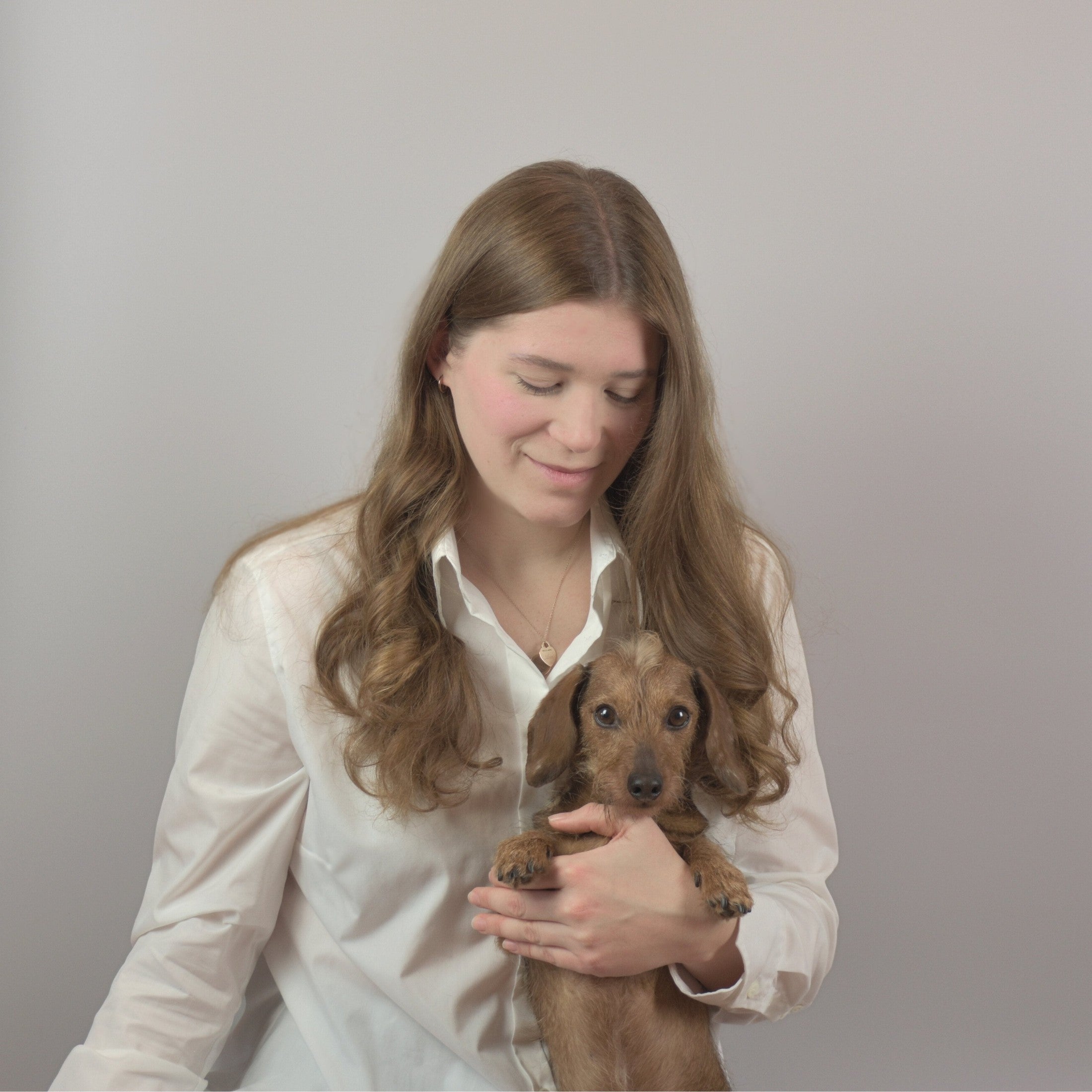

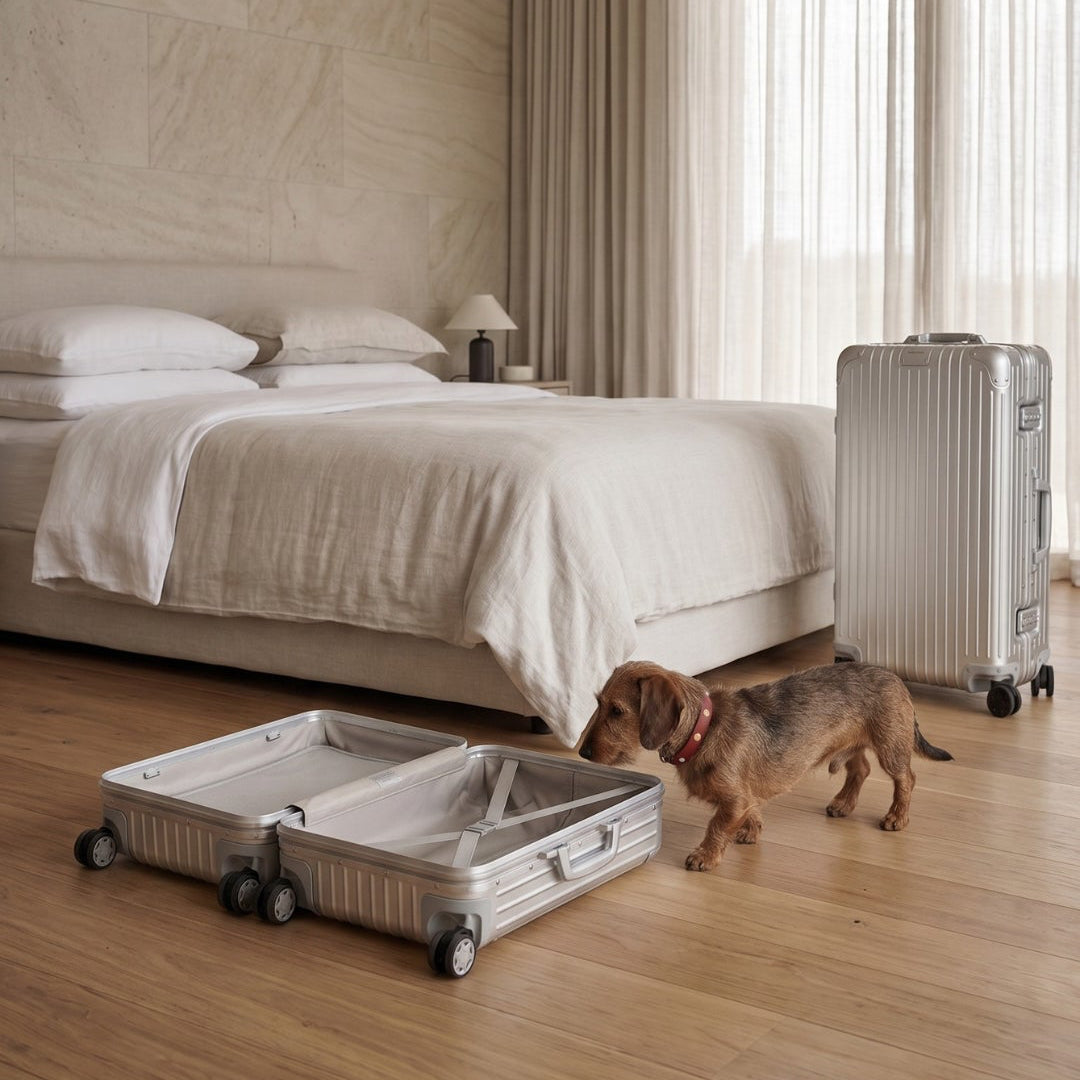
For a dog, a journey doesn't begin at the train station, the airport, or when checking into a hotel. It starts much earlier: with an open transport bag in the living room, with a short break on their own blanket, or with the first visit to a quiet bus stop, without even getting on.
Because traveling consists of much more than the actual ride. A dog has to classify new sounds, walk on unfamiliar surfaces, calm down in strange surroundings, and be able to wait for longer periods. They should be able to relieve themselves even if their usual patch of grass is missing, and possibly relax in a hotel room while doors slam in the hallway and a cleaning cart rolls by.
Many dogs can learn these skills. Problems usually arise when all demands converge on the day of travel. A dog who only knows their transport bag from the vet, never rests on a portable blanket at home, and is only left alone in their own living room, is suddenly expected to confidently handle a multi-hour journey, a hotel lobby, and an unfamiliar room.
Well-planned travel routines with a dog reduce this complexity. They create recurring sequences that give your dog orientation while the environment changes. This is not about toughening up your dog against all forms of stress. Good travel preparation means building up situations incrementally, recognizing boundaries early, and teaching your dog reliable strategies for rest, transport, and orientation.
Table of Contents
- 1. Why Travel Routines Are So Helpful for Dogs
- 2. How to Tell if Your Dog is Ready for the Next Step
- 3. Training with a Transport Bag, Crate, or Dog Backpack
- 4. Practicing Rest and Waiting Times on the Go
- 5. Teaching Your Dog to "Go" on Command
- 6. Getting Your Dog Used to Buses, Trains, and Public Transport
- 7. The Right Arrival Routine at the Hotel
- 8. Building Up Alone Time in the Hotel Room
- 9. Grooming Rituals as a Familiar End to the Day
- 10. Training Plan for Travel Routines
- 11. Travel Routines for Car, Train, Flight, and City Trips
- Frequently Asked Questions
Key Points at a Glance
- Don't train "traveling" as a whole, but rather transport, waiting, resting, bathroom breaks, and being alone as individual skills.
- Start in a low-stimulus, familiar environment and only increase one difficulty at a time.
- A transport bag or dog backpack should be voluntarily accepted long before the trip.
- A familiar blanket can become a mobile resting place if it has already been consistently associated with relaxation at home.
- A potty signal facilitates longer car rides, flights, restaurant visits, and stays in cities.
1. Why Travel Routines Are So Helpful for Dogs
Humans understand the process of a trip. We know why the suitcase is in the hallway, why we get up earlier than usual, and roughly how long a train journey will take. A dog, on the other hand, only sees a series of unfamiliar changes.
Breakfast is at a different time. The morning walk is shorter. Luggage is moved, doors are open, and the usual daily structure dissolves. This phase alone can make a dog restless even before the actual journey has begun.
A good travel routine doesn't explain to the dog where they are going. However, it makes the process more predictable. Not every time has to be precisely adhered to. Much more important is a recurring sequence. A possible sequence is:
Potty break, short movement, transport, water, rest, and then cautious exploration.
This sequence can remain similar during a car ride, at the train station, and later at the hotel. The location changes, but the basic pattern remains familiar. Routines are particularly helpful when they consist of clear signals. The transport bag doesn't suddenly mean loss of control, but a practiced retreat. A specific blanket signals a rest period. A short grooming routine shows that the active part of the day is ending. This way, the travel equipment is not just taken along, but acquires a recognizable function for the dog.
Founder’s Note: Our Arrival with Schoko
When I arrive at a hotel with Schoko, I don't immediately start unpacking my suitcase or looking for the nearest restaurant.
First, we go for a short walk. Then his familiar blanket gets a permanent spot in the room, water is provided, and Schoko is allowed to explore the new environment in peace. I usually sit down for a few minutes before I start unpacking myself.
This process seems unspectacular. That's exactly what makes it so helpful. The hotel room is new, but the sequence is not.
For short stays, it becomes particularly clear how valuable familiar routines are. A dog doesn't have to immediately love every room. It's enough for them to recognize where their resting place is and that no further hustle and bustle will follow after arrival.
2. How to Tell if Your Dog Is Ready for the Next Step
Travel training should not be progressed solely according to a fixed schedule. Two dogs can process the same exercise at different speeds. Even within a training session, daily form can vary.
A dog who was relaxed in their bag yesterday might be overwhelmed faster today by construction noise, heat, or a restless night. Therefore, it is more sensible to observe their behavior than to check off a certain number of days.
Relaxation Is More Than Just Being Still
A quiet dog is not necessarily a relaxed one. Some dogs react to being overwhelmed not by barking or pulling, but by freezing. They move little, stop taking food, and appear particularly "well-behaved" at first glance.
Therefore, pay attention to the overall picture. A relaxed dog usually shows softer body language, can look around, accepts food, and still reacts to familiar cues. After a brief stimulus, they return to a calmer state.
Possible signs of being overwhelmed include:
- frequent lip licking without food,
- repeated yawning without tiredness,
- heavy panting without heat or exercise,
- tucked tail,
- ears laid back,
- sudden freezing,
- restless pacing,
- severe trembling,
- food refusal,
- scratching at doors or transport bags,
- frantic searching for an exit.
A single signal does not necessarily indicate significant overwhelm. However, if several signs occur simultaneously or increase over time, the situation should be simplified.
Three Questions Before Each Progression
Before making an exercise more difficult, check:
- Is my dog participating voluntarily?
- Can they still respond to me?
- Do they recover quickly after the exercise?
If your dog enters their bag voluntarily, accepts food inside, and lies down again after a brief movement, the next step may be appropriate. If they have to be lifted in, scratch at the exit, or remain restless afterward, the task was still too difficult.
Only Change One Difficulty at a Time
Travel training consists of several factors:
- duration,
- distance,
- noise level,
- movement,
- crowd,
- unfamiliar surroundings,
- confined space.
Increase only one of these factors if possible. Five minutes of rest at home should not immediately become thirty minutes in a crowded train station hall.
A sensible intermediate step would first be a longer rest period at home. Then a short session in the hallway, later a quiet park bench, and only then a more frequented place.
This detailed preparation may seem slow. In practice, however, it often saves time because the dog has fewer negative experiences that would later have to be laboriously corrected.
3. Training with a Transport Bag, Crate, or Dog Backpack
A transport bag should not appear only on the day of travel. It must first become a normal part of everyday life.
Especially with small dogs, the habit of simply putting them in a bag easily develops. This works externally, but deprives the dog of the opportunity to get to know the place voluntarily. For a reliable travel routine, it is more helpful if the dog goes in by themselves and does not immediately associate the stay with closing, carrying, and loss of control.
Step 1: The Transport Option Becomes Part of the Room
Place the bag, crate, or backpack open in a quiet room. The entrance should be stable and easily accessible. Movable straps or flaps that could hit the dog should initially be set aside.
Leave the item visible for a few days. Place individual pieces of food first nearby, then at the entrance, and finally further inside.
The dog is allowed to decide how close they get. Avoid pushing them in or immediately closing the zipper after the first voluntary entry.
Step 2: Building Voluntary Entry
As soon as your dog investigates the entrance or puts a paw inside, this behavior can be calmly rewarded. In the next step, they only receive the reward when they go in completely.
A verbal cue like "bag," "backpack," or "travel spot" is only introduced when the behavior is already reliably offered.
At this point, the cue merely means to go to a specific place. It should not yet automatically announce that the dog will be enclosed or carried.
Step 3: Calming Down in the Open Bag
Many training sessions end with entry. For travel, however, it is not crucial whether the dog briefly enters the bag, but whether they can relax in it.
Therefore, gradually reward calm behaviors:
- standing still without immediately jumping out,
- sitting down,
- lying down,
- resting their head,
- relaxed observation.
A familiar surface can facilitate this step. With a dog backpack that has a removable sleeping mat, the blanket can first be used separately as a resting place. Later, it is placed in the open backpack. This way, the dog not only associates the shape of the bag, but also the smell and material with an already known relaxation exercise.
The PAWLII dog backpack is designed precisely for this transition: it not only serves as a transport solution for small dogs, but can also be opened into a protected resting place at the destination. For training, however, it should first be kept at home before actually being used on a trip.
Step 4: Training Closures Separately
For some dogs, it's not the bag itself that's uncomfortable, but the moment the zipper moves. Even the rustling of fabric, the closing of a flap, or a clicking carabiner can cause uncertainty.
Train these noises individually.
First, only move the closure without narrowing the opening. Then one side is briefly closed and immediately reopened. Only when the dog remains calm is the bag completely closed for one second.
The duration is extended in small increments. Open preferably before the dog scratches at the exit or becomes noticeably restless.
The dog should learn that calm leads to opening, and not frantic pushing.
Step 5: Adding Movement
Only when the closed stay works calmly is the bag moved.
First, lift it only a few centimeters and immediately put it down again. Then follow one or two steps through the room. Later, carry the dog briefly through the apartment, into the hallway, and finally out the front door.
This phase should not be underestimated. A bag standing calmly on the floor feels completely different to a dog than a swaying surface while being carried.
Pay attention to smooth movements. Hasty lifting, strong rocking, or carrying several pieces of luggage simultaneously can unnecessarily complicate the introduction.
Step 6: Simulating Travel Situations
Now, individual elements of a real trip are added:
- standing next to a rolling suitcase,
- being carried through a door,
- waiting in an elevator,
- lying under a table,
- sitting in a parked car,
- briefly being placed on a bench,
- hearing quiet train station noises.
Don't train everything at once. A dog being carried for the first time doesn't have to simultaneously cope with a noisy train station and a cramped elevator.
The more individual situations that are already familiar, the fewer new pieces of information they have to process on the day of travel.
When Training Should Be Paused
If the dog continuously scratches at the exit, pants heavily, refuses food, or frantically tries to escape, the step was too big.
Calmly open the bag and return to an easier exercise in the next session. The goal is not to keep the dog in the bag for as long as possible, but to enable them to have a reliable and safe stay.
4. Practicing Rest and Waiting Times on the Go
Traveling consists of a surprisingly large amount of waiting.
The train is delayed. The hotel room isn't ready yet. A group is in front of you at the reception. The taxi arrives late, or the order at the cafe takes longer than expected.
For humans, these phases are annoying but understandable. A dog doesn't recognize why movement suddenly stops. If they have never learned to wait calmly, they will find their own occupation. They observe every person, constantly change places, pull towards other dogs, or demand attention continuously.
Therefore, resting on the go is a separate training competence.
The Blanket as a Mobile Resting Place
A blanket cue can show the dog that no activity is expected for a certain period. The blanket does not become a place where the dog must lie still. Instead, it serves as a spatial orientation.
Start in a quiet room. Lay out the blanket and initially reward any voluntary contact. Later, the dog receives the reward when they fully stand on it, sit down, or lie down.
Food should be calmly placed between the front paws. This keeps movement small and the reward supports lying down rather than immediate jumping up.
Only when the dog seeks out the blanket on their own is a cue like "blanket," "break," or "resting spot" added.
A dog blanket for travel should be used regularly at home already. The PAWLII Alpaca Fleece Blanket, for example, can be used first in the living room, then on the balcony, and subsequently in quiet cafes. This way, it not only carries a familiar scent on travels but also signals a known routine.

Rest Must Be Learned in Different Places
Dogs do not automatically transfer what they have learned to every environment. A dog who relaxes for twenty minutes in the living room can become restless on a cafe terrace after two minutes. Therefore, gradually increase:
At Home:
Sit with a book or a cup of coffee next to the blanket. The dog is not constantly addressed or entertained.
Hallway or Entrance:
Here, quiet footsteps, doors, and voices are added.
Quiet Park Bench:
Choose a less frequented time of day. Stay for only a few minutes initially.
Cafe Terrace:
Find a spot on the edge, not in the middle of the walkway. The first visit should be short and not start with a long breakfast.
Train Station or Hotel Lobby:
These places are only added when quieter environments work reliably.
Combining Movement and Rest
Before a waiting period, the dog should have the opportunity to relieve themselves and move adequately. This does not mean physically exhausting them.
A short walk with enough time to sniff is often more helpful than frantic ball games. After high physical or emotional arousal, many dogs find it difficult to relax immediately.
A sensible sequence is:
- Potty break,
- short sniffing walk,
- water,
- blanket or travel spot,
- calm waiting period.
This sequence can later be repeated at the train station, in the hotel, and in the restaurant.
Using Engagement Purposefully
A toy or a small food search task can facilitate the transition into a waiting period. However, it should not fill the entire rest time.
The PAWLII Origami Sensory Toy can be filled with small pieces of food thanks to its folds, providing a limited search task. The crinkling element also stimulates sensory perception. It is especially useful if the dog is already familiar with the toy at home and does not react to it with excessive excitement.
After playing, the dog's blanket or familiar resting place should follow. This teaches the dog that not every minute of a trip needs to be actively filled.
For dogs that heavily disassemble toys or swallow fabric parts, such an activity should not be used unsupervised.
5. Teaching the dog to "potty" on cue
A potty cue is one of the most practical travel routines imaginable.
Before a long train ride, a flight, a visit to a restaurant, or getting into a carrier, it's helpful if the dog understands that now is a good opportunity to relieve itself.
The cue does not force the dog to urinate. It links a naturally occurring behavior with a specific word.
Step 1: Choose a clear cue word
Choose a short word that is not constantly used in everyday life. Possible examples include:
- "Pee-pee,"
- "Potty,"
- "Hurry up,"
- "Go."
All people who regularly travel with the dog should use the same cue.
Step 2: Observe the right moment
Start at times when your dog is very likely to need to relieve itself:
- immediately after waking up,
- after a long rest period,
- after eating,
- before the normal walk.
First, go outside as usual. Do not say the cue yet while the dog is looking for a suitable spot.
Step 3: Connect the word with the behavior
As soon as the dog begins to relieve itself, calmly say the chosen word only once.
Wait until it's finished, and reward it immediately afterward. The reward should be given quickly so that the connection remains clear.
Repeat this process over many walks.
Step 4: Gradually introduce the cue earlier
After enough repetitions, the word is no longer said only during the act of relieving itself, but a few seconds beforehand. The moment when the dog sniffs more intensely, turns, or visibly searches for a spot is suitable.
If it then relieves itself, a reward follows again.
If it doesn't react, the cue is not repeated multiple times. Walk a few steps further and try again later.
Step 5: The walk does not end immediately
If the way home begins immediately after every potty break, a dog can learn to delay relieving itself.
Therefore, often stay outside for a few more minutes. Allow a short sniffing phase or continue the walk.
This keeps the potty cue positive and does not automatically signal the end of activity.
Step 6: Incorporate different surfaces
Many dogs develop clear preferences for certain surfaces. A dog that only relieves itself on a large grassy area may have difficulties in city centers, at train stations, or at airports.
Therefore, practice gradually in different places:
- grass,
- dirt,
- gravel,
- urban tree pits,
- damp ground,
- unfamiliar walking paths.
Do not force the dog to relieve itself in an unpleasant place. The goal is greater flexibility, not a complete abandonment of its needs.
A realistic routine before departure
Allow enough time. Under time pressure, the cue is quickly repeated multiple times, while the dog itself is still tense or too distracted.
A sensible sequence is:
- find a quiet, suitable spot,
- allow a few minutes of sniffing,
- give the cue once,
- reward immediately after relieving itself,
- a short further movement,
- only then go to the bag, car, or platform.
If the dog cannot relieve itself, it does not necessarily mean that the training is not working. Perhaps it doesn't need to yet or doesn't feel safe enough in that location.
6. Acclimatizing the dog to buses, trains, and public transport
Public transport combines many different stimuli in a confined space. Rolling suitcases, announcements, doors, braking noises, strangers, and other dogs can all occur simultaneously.
Therefore, the first training session should not be an hour-long train ride.
Phase 1: Getting to know the environment
First, visit a quiet stop or the outer area of a train station without getting on.
Stay far enough away for your dog to observe and still accept food. Reward calm looking, voluntary eye contact, and orienting towards you.
The visit can be ended after a few minutes. A short positive experience is more valuable than a long stay that ends in overwhelming the dog.
Phase 2: Observing noises and movements
On subsequent days, you can move closer to the stop or platform. Let vehicles arrive and depart.
Pay particular attention to braking noises, compressed air, opening doors, and larger groups of people. Increase the distance if your dog reacts clearly stressed.
A greater distance is not a training setback. It allows the dog to process the stimulus at all.
Phase 3: Getting on without a long ride
At a quiet terminal stop, only getting on can be practiced first. Enter the vehicle, reward your dog, and get off again, provided the process is safe and possible without haste.
This way, getting on is not immediately associated with a long journey.
Phase 4: Taking a short ride
The first ride should take place outside of rush hour. Travel only one or two stops.
For small dogs, a positively built-up carrier or a dog backpack can reduce the number of direct stimuli. Larger dogs need a safe place close to you, preferably out of the way.
For longer train journeys, place a familiar blanket under the seat or in the designated spot. This transfers the already practiced calm behavior to the new environment.
Phase 5: Gradually increasing travel time and transfers separately
First, extend the journey without simultaneously switching to a busier time. Transfers will be added later as a separate training stage.
A tight connection is unsuitable for the first journeys. Plan enough time for a potty break, a drink of water, and a short orientation break.
Behavior at the platform
Keep the dog close to you on a short but loose leash. Avoid proximity to the platform edge and, if possible, do not stand in the densest crowd.
For small dogs, it may be safer to transport them in their trained carrier in highly frequented areas. However, this assumes that staying in it works in a relaxed manner.
Don't forget muzzle training
Depending on the means of transport, region, and size of the dog, a muzzle may be required. Train it independently of the actual journey.
The dog should voluntarily put its snout in, breathe calmly, pant, and be able to drink. A muzzle that is put on for the first time at the platform can significantly complicate an already unfamiliar situation.
Before each trip, check the current terms and conditions of carriage of the respective transport company. Regulations regarding carriers, tickets, and muzzle requirements differ.
7. The correct arrival routine at the hotel
The first few minutes in a hotel often influence the entire stay.
After a long journey, people usually want to check in, unpack, and quickly get to the first item on their agenda. However, for the dog, this sequence means that the strenuous journey is immediately followed by another new situation.
A calmer arrival helps it to grasp the space and find a fixed point of reference.
Before entering the hotel
If possible, plan a short walk. The dog should have the opportunity to relieve itself, drink water, and sniff at a calm pace.
This walk doesn't have to be long. After a stimulating journey, additional intense activity can even be too much.
Observe what your dog needs. Some dogs relieve physical tension through movement. Others primarily need a quiet place and fewer stimuli.
Check-in
Hotel lobbies are often confusing. Luggage is moved, doors open, people approach the dog, and other guests pass by closely.
If possible, find a spot on the side. Use the familiar blanket cue or let a small dog stay in its trained carrier.
If you are traveling as a pair, one person can wait outside with the dog while the other checks in. Not every situation needs to be managed simultaneously during the first hotel stay.
The first few minutes in the room
Before the dog explores freely, check:
- Is the room door securely closed?
- Is there a balcony or terrace?
- Are food, minibar, or waste accessible?
- Are medications or cleaning products left open?
- Are there places where the leash or harness could get caught?
Afterward, the dog is allowed to quietly examine the room.
Provide water and place the familiar blanket in a sheltered spot. A place to the side of the bed, under a table, or in a quiet corner is usually more suitable than the area directly next to the door.
The dog backpack can be left open nearby. If the dog already knows it as a resting place, it creates a small familiar zone within the new room.
Arrive together first
Sit down for a few minutes. Don't immediately start completely unpacking your suitcase, opening the door multiple times, or walking back and forth in the room.
Observe whether your dog:
- drinks water,
- accepts food,
- lies down,
- no longer constantly checks the door,
- can react to familiar cues.
Only when it has visibly oriented itself should the next step follow.
Don't overplan the first hour
For many dogs, it makes sense to first stay together in the room and then take a quiet walk in the vicinity.
A packed schedule immediately after arrival gives the dog hardly any time to process the journey. Especially in cities, a longer rest period in the early afternoon is often more valuable than an additional program item.
Travel routines should not lead to the dog having to perform every moment. They help to sensibly alternate activity and rest.
8. Building up alone time in the hotel room
A dog that can relax alone at home may still react uneasily in a hotel room.
The environment is unfamiliar. Doors slam in the hallway, voices are heard, and cleaning carts move directly outside the room. At the same time, the room smells of unknown people and animals.
Therefore, alone time is not fully transferable to new places. It must be built up again step-by-step in an unfamiliar environment.
First, clarify hotel rules
Not every dog-friendly hotel allows animals to be left alone in the room. Ask before booking or at check-in at the latest:
- Is the dog allowed to stay unsupervised in the room?
- Is there a time limit?
- Does the reception need to be informed?
- Can the cleaning service be suspended?
- Is there a special door hanger?
- Does the hotel offer a dog sitter or partner service?
Verbal or written confirmation prevents misunderstandings.
Training does not begin at the hotel
Before practicing separation in an unfamiliar environment, your dog should already be able to stay calmly alone at home.
Observe its behavior not only when you leave but also during your absence. A camera often shows that a dog becomes restless after a few minutes, even though it appears to be waiting calmly at the door upon your return.
Signs of severe separation stress include:
- persistent barking or howling,
- scratching at doors,
- heavy panting,
- drooling,
- restless pacing,
- destroying objects,
- escape attempts,
- complete food refusal.
In such cases, alone time should not be tried further during vacation. Instead, arrange for care and seek professional support if needed.
Stay together in the hotel first
Do not practice separation immediately after entering the room. The dog should first get to know the room, be able to relieve itself, and have experienced at least one calm phase with you.
For the first hotel trip, it may be advisable to completely forgo alone time. Not every skill needs to be trained during every stay.
Step 1: Short physical separation in the room
Go into the bathroom and close the door for one second. Return before the dog becomes restless.
Repeat this process with slightly extended durations. If the dog remains on its blanket or in the open backpack, this can be calmly affirmed.
Step 2: Opening the room door
Step briefly into the hallway and immediately return. Do not make a big deal out of the return.
The goal is an unspectacular process. The dog should learn that the door can close briefly without a long separation following.
Step 3: Staying outside for a few seconds
Slowly extend the duration. A camera or a second smartphone can help observe behavior in the room.
If the dog immediately gets up and walks to the door, this is not yet a cause for concern. However, if it cannot relax again, begins to bark, or scratches, the step was too big.
Step 4: Varying the distance
First, only walk a few steps down the hallway. Later, a short walk to the elevator or reception can follow.
Do not change distance and duration simultaneously. A longer walk should initially only last a few seconds.
Step 5: A short real absence
Only after several relaxed mini-exercises can a short absence of a few minutes be attempted.
A long dinner, a spa visit, or a multi-hour city stroll are not suitable first tests.
Prepare the room
Before a short separation, the dog should have:
- had a potty break,
- been adequately exercised,
- access to water,
- be able to lie on its familiar resting place.
Close the curtains if there are strong external stimuli. Hang the notice for housekeeping on the door and inform the reception.
A familiar toy can accompany the first phase of separation. The Origami Sensory Toy can be prepared with a few pieces of food and offers a familiar search task. However, it should only be used if the dog handles it safely.
If it doesn't accept the otherwise favorite toy after you leave, this can be a sign that it is too tense.
An enrichment toy does not replace alone-time training and does not resolve separation anxiety.
Make returns calm
Greet your dog kindly, but without great excitement. Then take a short walk or offer water.
If the dog is clearly stressed upon your return, the next separation will be shorter or omitted entirely.
The goal is not to be able to travel without the dog for as long as possible during vacation. It is about safely and responsibly managing short, necessary situations.
9. Grooming rituals as a familiar end to the day
Not every travel routine must be directly related to transport or obedience. A calm grooming routine can also provide orientation.
After a long day in a new city, at the beach, or in a hotel, the dog has processed numerous impressions. A consistently similar end to the day can help separate activity and rest.
Grooming must be built up positively beforehand
A brush does not automatically have a relaxing effect. Some dogs enjoy brushing, while others find certain body parts uncomfortable.
Therefore, start at home with very short sessions. Show the brush, touch an insensitive area, and reward calm behavior.
One or two brush strokes are enough at the beginning. End the session before the dog tries to get away.
Over time, a cue like "Groom" or "Evening" can be added.

A Possible Evening Routine While Traveling
After the last short walk, the routine could be as follows:
- Offer water,
- Check paws and fur for dirt or small injuries,
- A few gentle brush strokes,
- Remove harness or collar,
- Lay out blanket at designated sleeping spot,
- Reduce light and activity.
The compact PAWLII travel brush made of beech wood is easy to store in your luggage. It is particularly suitable for short grooming rituals after walks, when sand, loose hair, or small impurities need to be removed from the fur.
What matters is not how long the grooming takes. Two calm minutes in a recurring sequence can already show the dog that the active part of the day is ending.
10. Training Plan for Travel Routines with a Dog
The following training plan is a guide. The individual weeks are not fixed deadlines. If a dog remains insecure about a task, the phase is extended.
Week 1: Getting to Know Resting Place and Travel Items
In the first week, transportation is not yet the focus.
Establish travel routines in a familiar environment. The blanket is used daily for short rest periods. Travel bag, crate, or dog backpack are open in the room.
Reward voluntary approaches and first calm moments. At the same time, you can begin to use the potty cue during natural urination.
The goal of the week is not for the dog to stay in the bag for long periods. He should first perceive the items as a normal part of his environment.
Week 2: Closures and Short Movements
Now, full entry is practiced. The bag is closed for a few seconds and immediately reopened.
Then, lift it briefly and set it down again. Carrying it for a few steps can also begin.
In parallel, extend rest periods on the blanket and continue practicing the potty cue in familiar places.
Week 3: Waiting and New Spaces
In the third week, first minor changes are added.
The blanket can be used in the hallway, at friends' houses, or in another room. The travel bag is carried briefly to the front door.
Practice waiting calmly for one to five minutes, while you sit yourself and do not constantly entertain the dog.
The potty cue is used in a second or third location.
Week 4: Public Places
Now, first short visits to quiet public places follow.
Suitable locations include:
- a sparsely visited park bench,
- the outdoor area of a cafe,
- a quiet bus stop,
- the edge of a small train station,
- a short ride of one stop.
End each exercise while the dog is still responsive.
At home, a hotel situation can also be simulated. Lay out travel items in a less frequently used room and practice closing the door briefly.
Week 5: Combining Individual Skills
Now, several familiar elements are combined into a small travel routine.
An example:
- Targeted potty break,
- short bus ride,
- rest period on the blanket.
The situation should still remain manageable. It's not about a full day trip, but about connecting already familiar routines.
Week 6: The Dress Rehearsal
Plan a half-day trip without a distant destination.
Pack the usual travel equipment, follow the later departure routine, and use a mode of transport. Incorporate a short waiting phase and a calm break.
Then observe:
- When could the dog relax?
- Which noises were difficult?
- Did he accept food?
- Was the travel duration appropriate?
- Could he relieve himself on the way?
- Which items had a recognizable function?
- At what point did the situation become too strenuous?
This evaluation is more important than a seemingly perfect dress rehearsal.
11. Travel Routines for Car, Train, Flight, and City Trip
The basic building blocks remain the same. However, the focus shifts depending on the type of travel.
Travel Routine for Car Travel
A dog should first get to know the stationary car. Let him get in without driving off. This is followed by engine noise and very short rides.
A possible routine is:
- Potty break,
- short calm movement,
- secured place in the vehicle,
- short ride,
- break with water and relieving himself,
- another rest period.
Excessive salivation, vomiting, or persistent restlessness can indicate motion sickness or anxiety. In this case, the cause should be clarified by a veterinarian.
Never leave a dog unattended in a parked vehicle.
Travel Routine for Train Travel
Before entering the train station, the dog should be able to relieve himself. Plan enough time to avoid a hectic transition.
At the platform, the familiar blanket or bag cue follows. On the train, the dog has a designated spot out of the way.
For longer journeys, transfers should be generously planned. An extra break is usually more sensible than the fastest possible connection.
Travel Routine for a Flight with a Small Dog
Air travel requires particularly thorough preparation of the carrier bag.
The dog should not only lie calmly in it but also be familiar with the following situations:
- Bag is lifted,
- Bag is on a luggage cart,
- Bag is placed under a low seat,
- strangers moving nearby,
- longer periods without movement,
- being taken out and re-entering.
Relieving oneself on unfamiliar surfaces can also become relevant.
Check the current airline regulations directly before booking. Dimensions, weight limits, and carry-on conditions sometimes differ considerably.
Travel Routine for a City Trip
City trips often alternate between movement and stillness. The dog walks through new streets, waits in a cafe, travels by public transport, and then needs to settle down in the hotel.
A suitable daily rhythm could look like this:
- early calm walk,
- breakfast with blanket or travel spot,
- short sightseeing section,
- longer rest period in the hotel,
- potty break,
- another calm activity,
- evening walk,
- grooming ritual and sleeping place.
Especially in warm months, an early start is sensible. Midday can be used for an extended break.
An experienced travel dog does not need less sleep than at home. Due to the many new impressions, his need for rest can even increase significantly.
Conclusion: Relaxed Travel Comes from Everyday Life
A travel-experienced dog is not simply a dog who has visited many places. What matters is the skills he was able to develop along the way.
Can he voluntarily go into his carrier? Does he find peace on a familiar blanket? Can he tolerate short waiting times, relieve himself in an unfamiliar place, and relax again after new impressions?
These skills are not acquired during a single trip. They are built up in everyday life and then gradually transferred to new situations.
A good travel routine doesn't have to be complicated or perfect. Often, it's small, recurring routines that make the biggest difference: a potty break before departure, the same resting place in the cafe and hotel, a short activity during a waiting period, or a few gentle brush strokes at the end of the day.
Even travel essentials only unfold their true value through this repetition. The blanket becomes a resting place not solely because of its familiar scent, but because the dog has already learned to relax there at home. The dog backpack is not just luggage, but a prepared retreat. The sensory toy accompanies a familiar search task, and the travel brush becomes part of a calm end to the day.
Therefore, don't start just a few days before your vacation. Integrate the individual routines into everyday life early on, without time pressure and without overwhelming the dog with too many new demands at once.
The goal is not a dog who passively endures every situation. Calm Travel means structuring your shared rhythm so that safety, peace, and new impressions remain compatible.
In this way, travel becomes not a test that the dog must pass, but an experience for which you have prepared him step by step.
Editorial note:
This article does not replace a veterinary diagnosis or individual behavioral therapy. In cases of severe travel anxiety, persistent separation distress, vomiting, breathing problems, or clear flight reactions, a veterinary practice and, if necessary, qualified behavioral experts should be consulted.