

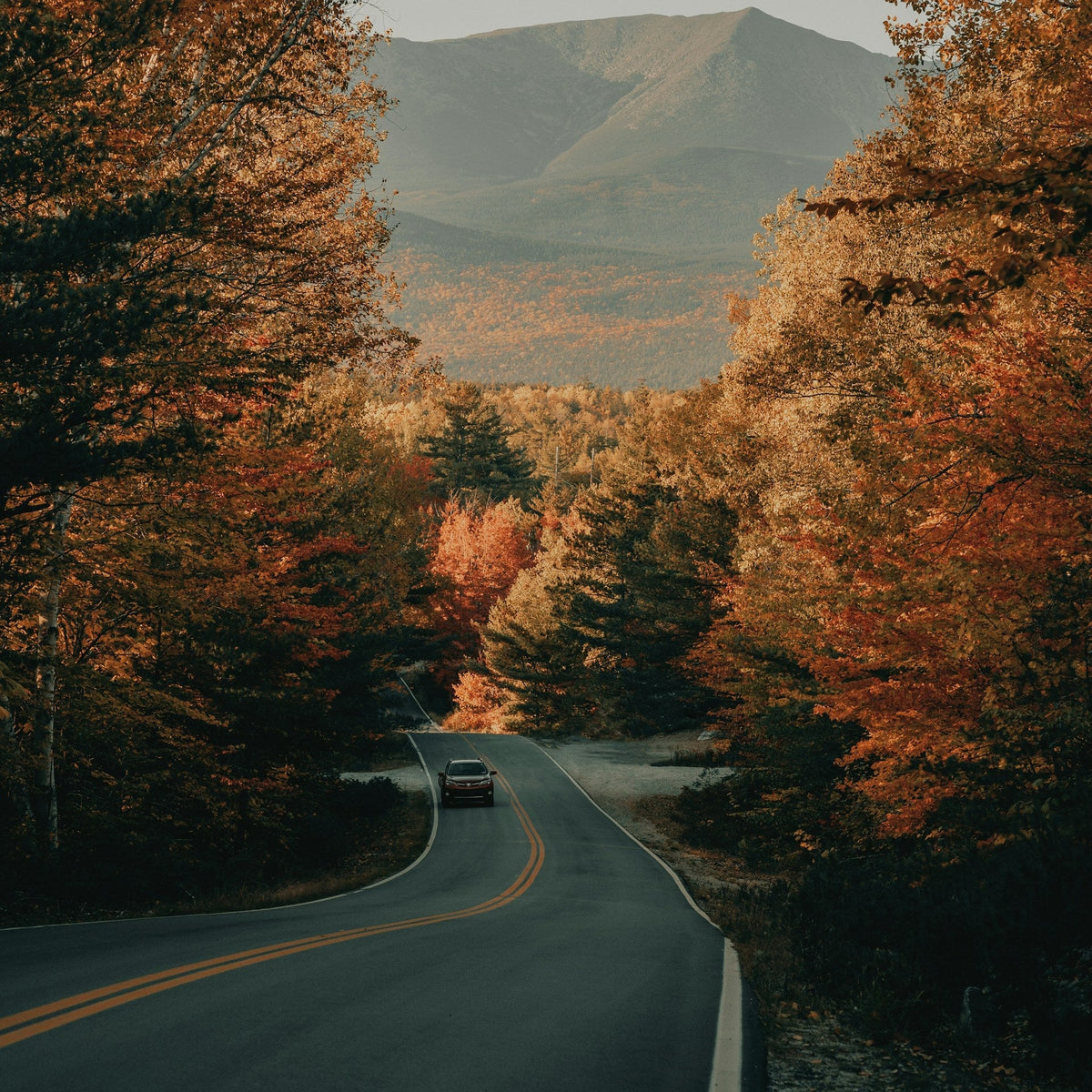
There are destinations that are best explored without a fixed schedule. New England is one of them. Narrow roads lead past white wooden houses, small farms, and old lighthouses. In the fishing ports of Maine, fishing boats bob in the water, while further west, the wooded mountains of Vermont and New Hampshire begin. Autumn brings about an almost daily transformation of the landscape: maple trees glow in shades of red and orange, the air turns cooler, and in the small towns, the season for apple cider and pumpkin pie begins.
For a road trip through New England with your dog, the combination could hardly be better. Instead of ticking off new sights every day, the individual legs of the journey can be planned to leave plenty of time for long walks, short breaks, and spontaneous discoveries. Many of the most beautiful places can be experienced on foot anyway: on the historic streets of Boston, along the rugged coastline of Acadia National Park, or on the expansive forest trails of the White Mountains.
New England comprises six states. However, for a trip of about ten to fourteen days, a carefully selected route through Massachusetts, Maine, New Hampshire, and Vermont is recommended. This combines the highlights of the landscape with exceptional accommodations without requiring your dog to spend several hours in the car every day.
In this guide, you will learn which route is particularly worthwhile, when you can experience the famous Indian Summer, and how to safely take your dog from Europe to the USA. You will also find five carefully researched dog-friendly luxury and boutique hotels, specific walks, and important entry requirements.
Table of Contents: Vacation with a Dog in New England
- Why New England is ideal for a road trip with a dog
- The best time to travel: Indian Summer and the quieter months
- Travel from Europe and entry requirements for dogs
- The most beautiful road trip route through New England with a dog
- Five dog-friendly luxury and boutique hotels
- Restaurants, cafés, and practical travel routines
- Conclusion: Discovering New England together and consciously
- Frequently Asked Questions
Key Highlights at a Glance: Vacation with a Dog in New England
- Best time to travel: Late September to mid-October for Indian Summer; May, June, and September for comparatively relaxed outdoor days.
- Ideal trip duration: 10–14 days, allowing plenty of time for walks and relaxation between the individual legs of the road trip.
- Recommended route: Boston → Portsmouth → Portland/Cape Elizabeth → Bar Harbor/Acadia → White Mountains → Vermont → Boston.
- Travel from Europe: Flight to Boston and onward travel by rental car. For small dogs, a suitable nonstop flight with confirmed cabin travel is particularly advisable.
- Important documents: CDC Dog Import Form, microchip, and, if applicable, additional entry and airline documents. For the return trip to the EU, a valid EU pet passport and valid rabies vaccination are particularly important.
Research status: October 29, 2026. Flight regulations, entry fees, and pet policies may change.
1. Why a Vacation with a Dog in New England is Special
Four States, Four Different Landscapes
What makes New England so interesting is the variety of coastlines, mountains, and small historic towns. Within just a few hours' drive, the surroundings change completely. In the morning, you can walk with your dog along the Atlantic, while a few days later you can hike through forests where the leaves change color in autumn.
Maine is characterized by a rugged Atlantic coastline, lighthouses, and small fishing villages. New Hampshire offers a much more mountainous landscape with the White Mountains, while Vermont is best known for its farms, covered bridges, and traditional villages. Massachusetts complements the trip with the historic architecture of Boston and its lively city neighborhoods.
For dogs, this variety means new experiences time and again. However, the route should not be planned solely to see as many places as possible. Staying at one accommodation for two or three nights is often more sensible than changing hotels every day. This leaves time to get to know the surroundings without making the entire daily schedule dependent on the next drive.
What Makes New England Dog-Friendly – and Where the Limits Are
In many parts of New England, dogs are visibly part of everyday life. Especially in smaller towns, walking paths are often directly accessible from the accommodation. Some hotels have specially designated dog-friendly rooms, provide bowls and dog beds, or offer recommendations for walks.
There is also much to discover together in terms of scenery. In Acadia National Park, for example, dogs are allowed on around 161 kilometers of hiking trails and 72 kilometers of historic Carriage Roads. However, certain beaches, buildings, and climbing routes remain off-limits.
Unlike in some European vacation destinations, taking dogs into restaurants is not a given. Often, only outdoor terraces are accessible. In autumn, this can quickly become a practical problem when it gets cold in the evening and terraces close.
This is why it is worth choosing accommodation not only based on its official dog-friendliness, but also on whether everyday life can genuinely be enjoyed together.
2. Vacation with a Dog in New England: When is the Best Time to Travel?
Indian Summer: Why Autumn is the Most Popular Time to Travel
Indian Summer is probably New England's best-known natural phenomenon. Between late September and October, large parts of the forests turn intense shades of yellow, orange, and red. Maple trees, in particular, create the typical autumn landscape that attracts visitors from all over the world every year.
The leaves usually begin to change color in the northern and higher-altitude regions. This is why it often reaches the mountains of Vermont and New Hampshire earlier than the coastal areas of southern New England.
|
Region |
Typical Period for Autumn Colors |
|---|---|
|
Northern Vermont and Higher Elevations |
Late September to Early October |
|
White Mountains, New Hampshire |
Early to Mid-October |
|
Southern Vermont and Woodstock |
Early to Mid-October |
|
Maine Coast and Acadia |
Early to Mid-October, Sometimes Later |
|
Boston and Southern Massachusetts |
Mid to Late October |
These timeframes are estimates. Temperatures, precipitation, and wind can significantly shift the autumn colors. Vermont therefore publishes a weekly Fall Foliage Report during the season, which is suitable for short-term planning.
For a road trip with a dog, the period from late September to mid-October is particularly attractive. Temperatures are often more pleasant than in midsummer, making longer walks possible.
However, autumn is also the region's peak travel season. Weekends during the peak foliage period can become particularly crowded. Traffic jams form on well-known scenic roads, parking lots at viewpoints are filled early, and popular hotels often need to be booked months in advance.
PAWLII Tip: Plan the most popular natural attractions for weekdays if possible. Especially with a dog, the early morning hours are often more pleasant: The paths are quieter, and you have to navigate through large groups of visitors less often.
Spring and Summer: New England Beyond Indian Summer
New England is also worth visiting outside the autumn season. In May and June, the gardens bloom and the coastal towns slowly awaken from their winter slumber. These months are interesting for relaxed walks and visits to small towns.
Summer offers long days and numerous outdoor opportunities. However, temperatures can rise significantly, especially inland. With a dog, longer hikes should then be scheduled for the early morning. Overheated wooden walkways, rocks, and asphalt surfaces can also become uncomfortable in the sunshine.
This is why September is an interesting alternative for a road trip along the coast: Many accommodations and restaurants are still open, while the strongest summer heat has usually passed.
In winter, however, conditions change fundamentally. Snow, road closures, and greatly reduced opening hours make a classic road trip considerably more challenging.
3. Vacation with a Dog in New England: Travel from Europe and Entry Requirements
Which Flight to Boston is Best for Traveling with a Dog?
The best starting point for a trip through New England is Boston Logan International Airport (BOS). From here, you can reach both the coastal regions of Maine and the inland landscapes by rental car.
If you are traveling from Germany, a nonstop flight is the most pleasant option – provided that the airline actually transports your dog on this route.
One important distinction: An airline may offer a flight connection to Boston while still excluding dogs from travel on that exact route.
Condor – Particularly Interesting from Frankfurt
Condor offers seasonal nonstop flights between Frankfurt and Boston, usually from May to the end of October. The flight time is approximately 8 hours and 15 minutes. Dogs weighing up to a total of 8 kg, including their carrier, can travel in the cabin after prior confirmation. Maximum carrier size: 55 × 40 × 23 cm.
KLM – Alternative via Amsterdam
KLM allows small dogs weighing up to 8 kg, including their carrier, to travel in Economy Class on suitable flights. The maximum carrier dimensions are 46 × 28 × 24 cm. On intercontinental flights, pets are not permitted as cabin baggage in Business Class. A booking should be made early, and no later than 48 hours before departure.
Lufthansa and SWISS – Boston Currently Limited
Although both airlines fly to Boston, they are currently not accepting new regular dog bookings to this US destination airport. As alternative US entry airports, New York-JFK or Newark may be possible under certain conditions.
For smaller dogs, a direct Condor flight to Boston is therefore particularly advisable. If such a connection cannot be booked for your travel dates, KLM via Amsterdam is an alternative. Be sure to check both flight legs, the aircraft type, and the airline actually operating the flight.
It is also important that your dog can comfortably stand, lie down, and turn around in the closed carrier. Weight limit alone does not determine whether a carrier is suitable.
For larger dogs, transport in the climate-controlled cargo hold may be an option. Here, you should carefully check the transport conditions, possible aircraft restrictions, and the dog's individual health status.
US Entry Requirements for Dogs from Germany and Europe
Since August 2024, new regulations have applied in the USA for the importation of dogs. For dogs that have spent the six months before their entry exclusively in countries with no or low risk of canine rabies, the requirements are comparatively straightforward.
For a dog entering from Germany, for example, and that has not previously visited a high-risk country, the following requirements apply in particular:
-
The dog must be at least six months old upon entry.
-
It must have a microchip recognizable by a universal reader.
-
It must appear healthy upon arrival.
-
A free CDC Dog Import Form must be completed for each dog.
-
The corresponding proof must be able to be presented.
For this group of countries, the CDC form is generally the only entry document required by the CDC. However, additional airline, USDA, and individual state regulations may apply.
The form can be completed online. After confirming your email address, you will receive a receipt that you can carry digitally or in print. The CDC recommends doing this several days before departure.
Official information can be found on the CDC website for dogs from countries with low rabies risk.
ESTA, Pet Passport, and Return Travel to Europe
In addition to your dog's entry documents, you will, of course, need your own travel documents. Travelers with a German passport can generally use the Visa Waiver Program with ESTA for tourist stays, provided they meet its requirements. The official fee for an approved ESTA application is currently 40.27 US dollars.
For the return trip to Europe, you should check the EU pet passport and valid rabies vaccination in good time.
The USA is one of the third countries from which no additional rabies antibody test is required when entering the EU. A correctly completed EU pet passport can be used upon return after a temporary stay, provided the required vaccinations and information are documented in it.
A sturdy travel folder is suitable for all documents, where the EU pet passport, the CDC confirmation, the airline documents, and the veterinarian's contact details can also be kept at hand. Especially at international airports, such a routine makes the individual security steps easier.
Rental Car: How to Turn the Arrival into a Relaxed Road Trip
After a long transatlantic flight, you should not start the road trip immediately with a multi-hour drive.
Plan at least one overnight stay in Boston. This gives your dog the opportunity to move around after the flight, drink enough, and get back into a regular daily routine.
For the onward journey, a rental car is the most practical choice. A medium-sized vehicle with enough space for luggage and a securely fastened dog transport solution is often sufficient.
Important: Ask the rental company about the conditions for taking animals along. Some providers charge additional cleaning fees if pet hair or dirt is left behind.
Secure your dog during the drive with a suitable transport box or a tested safety system. Small dogs should not be transported unsecured on the passenger seat or in your lap.
4. Vacation with a Dog in New England: The Most Beautiful Road Trip Route
For a balanced trip, PAWLII recommends a circular route starting and ending in Boston. It combines historic cities with the most important natural landscapes and deliberately avoids visiting all six states within a few days.
Recommended Route: 12 Nights
Massachusetts → New Hampshire → Maine → New Hampshire → Vermont → Massachusetts
The route covers roughly 1,200 to 1,400 kilometers without major detours. Additional time should be planned for photo stops, coastal excursions, and hikes.
Leg 1: Boston – the Perfect Start in New England
Boston combines American history with architecture reminiscent of European cities. Beacon Hill, one of the oldest city neighborhoods, is particularly well suited for a first walk with your dog.
The narrow streets are lined with historic brick houses, wrought-iron railings, and old gas lamps. In the mornings, before the morning rush hour begins, you can often experience the small alleys in a quieter atmosphere. Start the walk on Charles Street and then walk towards the Boston Public Garden. The expansive paths and well-maintained green spaces offer a pleasant contrast to the city streets. From here, it is not far to the Charles River Esplanade. The path along the river offers more space and is particularly pleasant for dogs that want to walk longer distances again after the flight.
For the first day, this combination is already sufficient. You can easily do without additional museums or large sightseeing programs with a dog.
PAWLII Tip: Leave your rental car parked during your stay in Boston if possible, or pick it up only on the day you continue your journey. Many central parking lots are expensive, while the most beautiful neighborhoods are perfect for exploring on foot.
Stage 2: Portsmouth and Cape Elizabeth – Historic Port Towns and Coastal Landscapes
Leave Boston heading north and follow the coast to Portsmouth, New Hampshire. The small port town is an ideal stopover. Around Market Square, you will find historic buildings, independently owned shops, and small cafes. Portsmouth can be easily explored on foot, allowing your dog to take a break from the car ride. The route then continues into Maine, where the landscape becomes increasingly maritime.
A particularly beautiful starting point is Cape Elizabeth, south of Portland. Here, with the famous Portland Head Light and the surrounding coastal trails, lie some of New England's most iconic sights. Around Fort Williams Park, you can walk with your dog on a leash and enjoy the view of the lighthouse. The atmosphere is especially pleasant in the early morning when the sun rises over the Atlantic and large groups of visitors have not yet gathered at the viewpoints.
Portland is a great option for the afternoon. The city has a historic port, galleries, independent shops, and an interesting restaurant scene. Walk with your dog through the Old Port District or along the Eastern Promenade. From the green spaces, you can enjoy views across Casco Bay, while your dog gets plenty of exercise after the drive.
If you prefer a quieter pace, you can spend the rest of your time on the beach at Cape Elizabeth. However, be aware of the seasonal dog rules: Dogs are generally not allowed at Crescent Beach State Park from April 1 to September 30. Outside this period, the respective park and leash rules still apply.
Stage 3: Bar Harbor and Acadia National Park – Maine's Rugged Coast
Days 5–7 · Bar Harbor, Maine
From Portland, the journey continues north to Bar Harbor on Mount Desert Island. This stage includes some of the longer drives of the road trip. You should plan approximately four hours or more, including breaks.
Bar Harbor is a charming coastal town with historic buildings, small shops, and views of Frenchman Bay. Its proximity to Acadia National Park makes it an ideal starting point for several days in nature. The national park is known for its granite cliffs, forests, lakes, and rugged Atlantic coastline. You can explore many trails together with your dog.
The following walks are particularly recommended:
Ocean Path: Coastal Walk with Atlantic Views
Ocean Path is one of the most beautiful trails in Acadia National Park. It runs along the rocky coast and connects several well-known viewpoints. The route can be customized flexibly. Instead of walking the entire route, you can choose individual sections and turn back once your dog has had enough exercise. The path is partly rocky and can become slippery in the rain. Good shoes and a short leash are therefore advisable.
Jordan Pond and the Historic Carriage Roads
For dogs that prefer wide paths, the historic Carriage Roads are particularly pleasant. The old carriage roads lead through forests, past lakes, and over stone bridges. The surfaces are mostly gravel and are often easier to walk on than steep mountain trails. Around Jordan Pond, you will find impressive views of the surrounding mountains. However, please note that individual sections of the shoreline path lead over narrow footbridges and rocky ground. For older or smaller dogs, a shorter walk on one of the Carriage Roads may be the more pleasant option.
Bar Harbor Shore Path: An Evening Walk
After a day in the national park, a quiet walk on the Shore Path in Bar Harbor is worthwhile. The path begins near Agamont Park and runs along the coast, past historic properties, with views of the small islands in the bay. Especially in the evening, this is a nice way to end the day without any further driving.
What Rules Apply to Dogs in Acadia National Park?
Although Acadia is relatively dog-friendly, there are clear restrictions. Dogs must always be kept on a leash no longer than approximately 1.8 meters. They are not allowed, among other places, on challenging ladder and climbing trails such as the Beehive Trail or the Precipice Trail.
Dogs are excluded from Sand Beach from June 15 to September 8, and from Echo Lake Beach from May 15 to September 15. Regular pets are also not allowed in public buildings or at ranger programs.
One special feature is the Cadillac Summit Road. For driving up, a timed vehicle reservation is required in addition to the regular park entrance fee during the reservation season. In 2026, this applied from May 20 to October 25; the reservation cost 6 US dollars per vehicle.
Important for travelers from Europe: Since 2026, the National Park Service has charged visitors without a US residence aged 16 and over an additional fee of 100 US dollars per person in Acadia National Park, unless a corresponding valid pass is used. In addition, the regular park entrance fee generally applies, for example 35 US dollars for a private vehicle.
A Perfect Day with Your Dog in Acadia National Park
Start early with a walk along Ocean Path. In the morning, the light along the coast is particularly beautiful, and the well-known viewpoints are often less crowded. Afterward, a longer break in Bar Harbor is a good idea. Lunch on a dog-friendly patio or a small picnic by the harbor will give your dog an opportunity to rest.
For the afternoon, choose a quiet section of the Carriage Roads. Instead of a second challenging hike, a 45- to 60-minute walk is often sufficient. In the evening, return to Bar Harbor. Especially after a day full of new smells and impressions, a quiet end to the day is more sensible than another excursion.
48 Hours in Bar Harbor with Your Dog
|
Time |
Day 1 |
Day 2 |
|---|---|---|
|
Morning |
Ocean Path and coastal views |
Carriage Roads near Eagle Lake |
|
Noon |
Break and lunch in Bar Harbor |
Picnic with views of the park |
|
Afternoon |
Walk along the Shore Path |
Cadillac Mountain, with a reservation if required |
|
Evening |
Quiet evening at the hotel |
Short walk by the harbor |
Stage 4: White Mountains – Scenic Roads and Mountain Walks
Days 8–9 · New Hampshire
After several days on the coast, the journey continues inland. The landscape changes significantly: small coastal roads become long stretches of forest, and the mountains of the White Mountains appear on the horizon. Plan for the drive from Bar Harbor to the White Mountains to take up almost an entire travel day. Depending on the destination, route, and breaks, it can take about five hours or more.
One of the region's scenic highlights is the Kancamagus Highway, a scenic road approximately 55 kilometers long between Conway and Lincoln. Especially during Indian Summer, the route offers impressive views of forested mountains and valleys.
Numerous viewpoints and shorter walking trails are located along the way. Well-known stops include Rocky Gorge and the area around Sabbaday Falls. Some trails are rocky or involve stairs, so you should choose a suitable route depending on your dog's fitness and size. The Kancamagus Highway has no gas stations, and mobile phone reception may be limited along the route. Therefore, download maps before the drive and plan for plenty of time.
You do not have to drive to every viewpoint. Especially during the high season, parking lots fill up quickly. It is often better to stop at a quiet section and take a longer walk.
There are also numerous hiking trails around Mount Washington. However, the terrain can be very challenging. Weather changes, rocky trails, and strong winds should not be underestimated. For a relaxing vacation with your dog, walking trails in the valleys are often a better choice than a long summit hike.
Stage 5: Vermont – Covered Bridges, Small Farms, and Classic New England
Vermont provides a quiet conclusion to the road trip. Instead of dramatic coastal landscapes, you can expect small farms, old wooden houses, winding country roads, and traditional villages.
Woodstock is particularly beautiful, a historic village in the center of the state. The main street is lined with well-maintained houses, small shops, and traditional buildings. A walk across the historic Middle Covered Bridge is one of the classic Woodstock experiences. The covered wooden bridge crosses the Ottauquechee River and is one of the village's most famous sights.
In the fall, this walk can be wonderfully combined with a visit to the village. Instead of a long sightseeing program, you can stroll through the streets, grab a coffee, and explore the surroundings.
The surrounding forest trails are ideal for longer walks. Vermont has numerous state parks where dogs are allowed on designated hiking trails. As a general rule, they must be kept on a leash. However, beaches and picnic areas are closed to dogs in many parks.
If you have a little more time, you can discover other places from Woodstock. Stowe and the area around Route 100 are particularly known for typical Vermont landscapes. However, the same rule applies here: fewer stops can be more. A whole afternoon in a small town, a walk through the woods, and a quiet evening by the fireplace often convey more of Vermont than five sights in one day. From Woodstock, the route finally leads back to Boston. For the return trip, you should plan approximately three hours depending on traffic.
5. Vacationing with Your Dog in New England: Five Special Luxury and Boutique Hotels
A good hotel is more than just a nice place to stay overnight on a road trip with your dog. After a long drive, your dog should be able to go outside easily, find a quiet place to sleep, and feel comfortable without constantly reorganizing your daily plans.
Five properties have been selected for this route that expressly accept dogs while also fitting the high-quality, authentic New England travel experience.
An Overview of the Five Dog-Friendly Hotels
The Whitney Hotel – Boston, Massachusetts
The Whitney Hotel is located directly on Charles Street in Beacon Hill. The location is ideal for travelers who want to explore Boston on foot with their dog.
The hotel combines understated, classic design with modern rooms. Particularly convenient is its proximity to the Boston Public Garden and the Charles River Esplanade. For four-legged guests, there is the in-house "Whitney Wags" program with dog beds, treats, and other amenities.
Pet Policy: A maximum of two pets is allowed per room, each weighing no more than 50 lbs. The fee is 125 US dollars per stay and room. Dog-friendly rooms are located on the second floor. Pets may not be left unattended in the room. Whether dogs have access to the restaurant and all other common areas is not explicitly published and should be inquired about in advance.
Inn by the Sea – Cape Elizabeth, Maine
Inn by the Sea is one of the region's particularly dog-friendly luxury accommodations. The hotel is located in a spacious garden landscape near Crescent Beach and combines modern furnishings with views of the Atlantic. The atmosphere is less formal than in many classic luxury hotels. Guests can alternate between beach walks, relaxing in the garden, and trips to Portland.
There are selected dog-friendly rooms and suites for dogs. Particularly attractive is that no additional dog fee is charged.
Pet Policy: Dogs are welcome in designated accommodations at no extra charge and with no weight limit. The hotel asks for advance registration. Dogs may accompany their owners in the Fireplace Lounge as well as on designated outdoor terraces. The regular indoor restaurant areas are not explicitly confirmed as dog-friendly. The maximum number of dogs per room and the rules for unattended stays are not clearly published on the official hotel website and should be clarified in advance.
The Bayview Hotel – Bar Harbor, Maine
The Bayview is located slightly outside the lively town center of Bar Harbor. The location directly on the water offers a quiet starting point for trips to Acadia National Park.
The hotel has two ocean-level rooms specially designed for dogs. These have direct access from the terrace to the lawn, so you do not have to leave the hotel through the lobby for every short walk. Especially for dogs seeking rest after an active day, this is a thoughtful detail.
Pet Policy: A maximum of two dogs is allowed per room. Dogs may not be left unattended. The special dog page lists a weight limit of 40 lbs (approx. 18 kg) and a fee of 50 US dollars per room/night. You should have the binding fee and weight limit confirmed in writing before booking. Accessible areas outside the dog room, private terrace, and garden are not fully specified.
The Glen House – Gorham, New Hampshire
The Glen House is located at the foot of Mount Washington and offers a modern interpretation of a classic mountain hotel. Clean lines, natural materials, and large windows make the surrounding landscape the centerpiece of the stay.
For the road trip, the location is particularly convenient, as you can reach numerous hiking trails and scenic roads of the White Mountains from here.
Pet Policy: Dog-friendly accommodations are available in various room categories. The official fee is 40 US dollars per day. A dog bowl and small treats are provided subject to availability. Weight limits, the maximum number of dogs, and the exact access rules for the restaurant, terrace, and other hotel areas are not sufficiently published officially and must be confirmed directly with the hotel. If you are traveling with a dog, you should request a room with quick access to the outdoors. This way, you can easily unwind at the end of the day after a long hike.
Woodstock Inn & Resort – Woodstock, Vermont
The Woodstock Inn & Resort is one of Vermont's historic establishments. Located directly in the historic town center, it combines classic New England architecture with spacious rooms and a quiet resort atmosphere.
For dogs, the designated rooms on the Garden Level are particularly interesting. They are located near a designated dog walking area.
Pet Policy: A maximum of two dogs per room is allowed, with a combined maximum weight of 100 lbs. The non-refundable fee is 150 US dollars per room per night plus tax. Dogs are not allowed to be left alone in the room. Among other things, all dining establishments, the spa, pool, Athletic Club, Kelly Way Gardens, and Billings Farm & Museum are excluded. Dog beds and bowls are available upon request.
This makes the Woodstock Inn a great choice for travelers who primarily want to explore the surroundings together. However, those planning extensive hotel experiences including restaurant visits with their dog should take the restrictions into account.
6. Vacationing with a Dog in New England: Restaurants, Cafés, and Relaxed Travel Routines
Where You Can Eat Out with Your Dog
Culinary-wise, New England is one of the most diverse regions on the American East Coast. Fresh lobster from Maine, clam chowder, blueberries, and maple syrup are closely associated with the regional cuisine.
However, when traveling with a dog, it is advisable to plan restaurant visits a little differently than on a trip without a pet. In the USA, pets are often not allowed inside dining establishments. Outdoor terraces, on the other hand, can be dog-friendly, provided the establishment allows it.
A great address in Portland is the Rising Tide Brewing Company. At the independent brewery, there is an outdoor area where leashed dogs are expressly welcome. The establishment asks that dogs remain at your own table and avoid contact with other dogs.
For a classic Maine lunch right at the harbor, the Portland Lobster Company is ideal. The restaurant is known for lobster rolls and a casual atmosphere by the water. The outdoor terrace is regularly described as dog-friendly by guests; clarify the admission before your visit, as no clear official dog policy is published.
In Bar Harbor, the Side Street Cafe is one of the easy-going addresses for lunch or dinner. The restaurant expressly allows dogs on its outdoor terraces, but a maximum of one dog per table or group.
Alternatively, a picnic with a view of the harbor is an option in Bar Harbor. At Geddy's, you can get classic New England dishes to go, which you can enjoy, for example, at the nearby Agamont Park. The restaurant itself does not allow regular pets inside its premises.
Especially during Indian Summer, many outdoor terraces are still open. However, the evenings can already be cold. For traveling with a dog, a hotel with a good in-room dining selection or a suite with a small kitchenette is therefore particularly practical.
Small Travel Routines That Make the Road Trip More Pleasant
A road trip means many changing impressions for dogs. New smells, unfamiliar hotel rooms, changing sleeping places, and longer car rides can tire out even well-trained dogs.
Therefore, the crucial thing is not only daily exercise, but also the opportunity to relax after an exciting excursion. Plan a break approximately every two hours on longer driving routes. For some dogs, more frequent stops make sense, while others can relax well in the car.
Three simple habits help with the daily routine:
- A familiar sleeping place: A dog blanket or dog bed that is already known from home creates a consistent resting area. This can make orientation easier, especially with frequent hotel changes. For example, the PAWLII leather travel backpack can also be used as a resting place and is thus a practical travel essential for on the go – regardless of the requirements for an approved flight carrier.
- A small bag for walks: When getting out at viewpoints, you shouldn't have to search through your suitcase for a leash, poop bags, or treats. A well-organized walking bag with the most important utensils makes spontaneous stops easier.
- A regular evening: After an active day, dogs do not necessarily have to experience another restaurant, a city stroll, or a new excursion destination. A quiet evening at the hotel can be just as valuable.
Especially on long trips, it is worth adjusting the pace to the dog and not to the number of planned sights.
What Belongs in the Travel Luggage for a Road Trip with a Dog?
In addition to the usual travel documents, a few things are useful specifically for New England:
-
A suitable and safe transport solution for flights and cars.
-
A familiar dog blanket or bed, especially with frequent hotel changes.
-
A lightweight, foldable travel bowl and sufficient drinking water.
-
Leash, harness, and poop bags for hikes and intermediate stops.
-
A towel and a small brush for wet or dirty fur.
-
Tick protection, coordinated with the veterinarian, as well as any necessary medications.
-
Sufficient familiar food, especially for dogs with a sensitive digestion.
7. Conclusion: Consciously Enjoy a Vacation with a Dog in New England
A road trip through New England is a journey that thrives on its contrasts. Between the lively streets of Boston, the small harbor towns of Maine, and the quiet landscapes of Vermont, there are often only a few hours of driving – and yet every section feels different.
Especially in autumn, the region unfolds its own character. The roads lead through colorful forests, it slowly gets quieter in the coastal towns, and the cooler temperatures invite long walks.
For a trip with a dog, New England offers many opportunities to be on the road together. The combination of dog-friendly hiking trails, charming boutique hotels, and small towns makes it easy to plan the day flexibly.
The crucial thing is to give the route enough time. Those who do not try to visit all six states in ten days, but consciously focus on a few regions, experience the landscape more intensely and at the same time create a more relaxed travel routine for their dog. And maybe that is exactly the special appeal of a road trip: not having to see everything, but really enjoying the places where you arrive together.