
A dog walking bag is one of those accessories whose usefulness often only becomes apparent in everyday life. Poop bags, treats, keys, and a smartphone can fit in a jacket pocket, but as soon as a clicker, a small collapsible bowl, a spare leash, or personal items are added, a quick walk can easily turn into a chaotic search.
A well-designed dog walking bag creates fixed routines. It keeps important utensils at hand, frees up your hands, and prevents treats from getting mixed up with your smartphone and keys. At the same time, a good bag doesn't have to look like classic training equipment. Especially when the walk is combined with a coffee shop visit, a city stroll, or a trip, the material and design play just as important a role as the number of compartments.
But which dog walking bag suits which everyday life? Is leather too delicate for walks? Is cotton always the more practical choice? And which functions are actually needed regularly? This guide shows what matters when it comes to material, organization, carrying comfort, and style.
Table of Contents
- What a good dog walking bag should do
- Treat pouch or full dog walking bag?
- Which material is suitable for a dog walking bag?
- Leather, cotton, and technical fabrics compared
-
Which functions are really important in everyday life
-
How to comfortably carry a dog walking bag
- Decision-making aid for the right dog walking bag
-
Cleaning and care of different materials
- Conclusion: Dog Walking Bag
- Frequently asked questions
The most important things about a dog walking bag at a glance
- The right dog walking bag depends on your daily life, not just its capacity.
- Leather is particularly suitable for a durable, dimensionally stable bag with a calm and high-quality appearance.
- Washable cotton is uncomplicated, lightweight, and particularly practical for regular use with treats.
- An integrated poop bag dispenser, easily accessible compartments, and flexible carrying options are usually more important than as many details as possible.
- Personal items and loose dog snacks should ideally be stored separately.
What a good dog walking bag should do
A dog walking bag is neither a miniature handbag nor merely a larger treat pouch. Its task is to simplify the recurring actions during a walk.
This includes three main requirements: important utensils must be quickly accessible, the bag should not interfere with walking, and its contents must be able to be sensibly separated from each other. A bag can have many compartments and still be impractical if the poop bag dispenser is on the wrong side or a treat can only be reached by opening two zippers.
Therefore, before buying, don't first consider how much fits into the bag. What is decisive is rather what you actually use during a typical walk.
For a short morning walk, this might only be poop bags, keys, and a few small treats. On the way to the office or a café, a smartphone, card holder, and headphones are added. For an outing, you might need water, a collapsible bowl, a small toy, and a light spare leash.
Treat pouch or full dog walking bag?
The terms treat pouch, food bag, and dog walking bag are often used interchangeably in retail. In reality, they fulfill different tasks.
The treat pouch
A treat pouch is primarily intended for dog training. It is attached to a belt, clothing, or a separate strap and allows quick access to rewards.
For a focused training session, this reduced form can be ideal. However, keys, smartphones, and personal items usually have to be stored elsewhere. Many models also look significantly sportier and are less intended for a subsequent restaurant or city visit.
The dog walking bag
A complete dog walking bag combines dog accessories and personal essentials in a compact format. Typically, it offers space for poop bags, treats, keys, phone, and smaller utensils. Depending on the model, separate outer pockets, attachment loops, or an integrated poop bag dispenser are added.
It is particularly suitable for people who do not want to carry an additional handbag during their walk or who regularly combine their dog walk with other errands.
The fanny pack
A fanny pack sits close to the body and usually moves less during brisk walking or training than a loosely worn shoulder bag. This is practical if you often bend down, train with your dog, or are on uneven paths.
However, the position must match your own clothing style and clothing. For example, a hip belt may be less comfortable over a coat than a crossbody strap.
The crossbody dog walking bag
A crossbody dog walking bag is worn diagonally across the upper body. The weight is distributed more evenly than with a one-sided shoulder bag, while both hands remain free.
This form can usually be integrated particularly well into everyday life. With a suitable size, it can be carried not only during a walk but also when traveling, visiting a café, or in the city.
Which material is suitable for a dog walking bag?
There is no universal winner when it comes to material choice. A bag for daily forest and rain walks has different requirements than a dog walking bag that is mainly used for city walks, restaurant visits, and travel.
The material decision should therefore answer four questions:
How often does the bag get dirty? Should it be fully washable? How important are dimensional stability and a high-quality appearance? And how much regular care do you want to take on?
From a sustainability perspective, a blanket assessment of individual fibers is also not very helpful. Material, workmanship, area of application, service life, and care must be considered together. The European Environment Agency emphasizes that the choice of material should match the required properties and the expected service life of a product.
Leather, cotton, and technical fabrics compared
| Material | Strengths | To consider | Especially suitable for |
|---|---|---|---|
| Leather | Dimensionally stable, durable, high-quality appearance, develops individual patina | Not machine washable, requires occasional care, moisture should not be allowed to soak in permanently | City, travel, café, restaurant, daily stylish use |
| Cotton or Canvas | Washable, lightweight, natural feel, uncomplicated in everyday life | Untreated, absorbs moisture more easily, can become softer after frequent washing | Everyday life, summer, training, travel, frequent use with snacks |
| Technical synthetic fiber | Often water and dirt repellent, lightweight, quick-drying | Often significantly sportier look, material feel and reparability vary | Forest, rain, intensive training, outdoor activities |
| Material mix | Can combine stability, low weight, and easy care | Care depends on the most sensitive component | Versatile everyday models |
The manufacturer's care instructions remain crucial regardless of the material. Coatings, linings, metal parts, and reinforcements can influence whether a bag can be washed, impregnated, or only superficially cleaned.
Leather dog walking bags
Leather offers a clear shape and makes a functional dog bag look more like a regular fashion accessory. This is particularly relevant when the walk doesn't end at the dog park but transitions into the rest of the day's activities.
High-quality leather can last for many years with careful use. Small signs of wear and tear are part of the material's development and should not automatically be seen as a defect. At the same time, leather is not entirely impervious. Permanent moisture, unsuitable cleaning agents, and improper storage can affect the surface and shape.
A leather bag is therefore not an ideal choice if it is to be put in the washing machine after every round. However, it can be very suitable for everyday use if treats are protected or transported in a separate insert and superficial dirt is regularly and carefully removed.
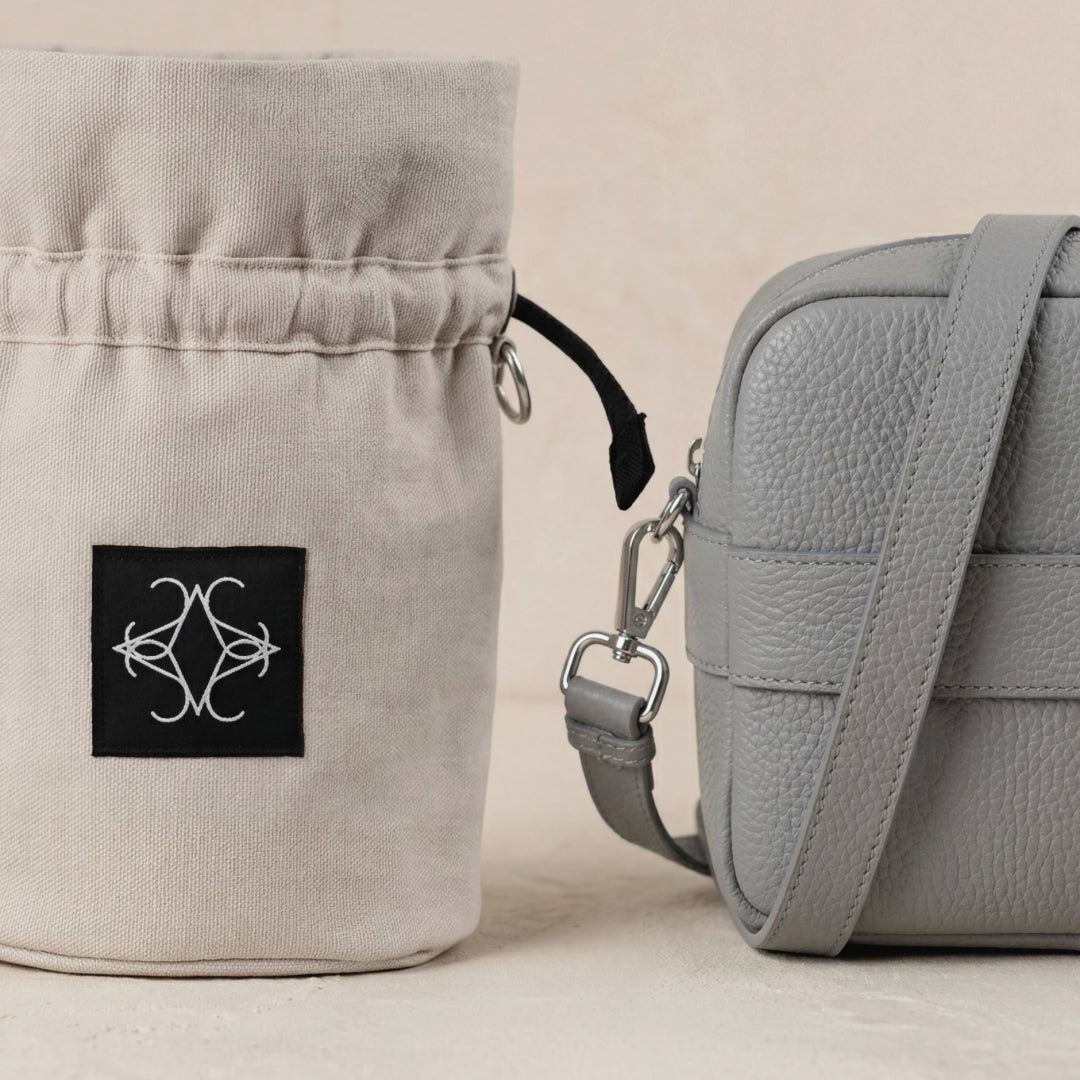
The PAWLII Crossbody Dog Walking Bag, for example, is made of Italian Nappa leather and designed as a calmly styled everyday bag. An integrated poop bag dispenser and an outer pocket combine the leather look with typical requirements of a walk.
Cotton dog walking bags
Cotton is a natural, renewable fiber that can be processed softly or firmly depending on the fabric construction. Textile Exchange describes cotton as a strong and versatile natural material.
The biggest practical advantage of a cotton bag is often its washability. Especially when transporting treats that crumble or leave grease stains, a machine-washable bag can significantly simplify everyday life.
However, "cotton" does not automatically mean that every model can be washed at high temperatures or tumble-dried. Reinforcements, lining, coatings, and metal parts determine the specific care. Therefore, always follow the product's care instructions.
The PAWLII Cotone Dog Walking Bag is made of 100 percent cotton and, according to the manufacturer, can be machine-washed at up to 30 degrees. It can be worn either on a belt or with a separately available crossbody strap. A side poop bag dispenser and an external attachment option complement the compact shape.
This fulfills a different need than the leather version: less structured elegance, but particularly uncomplicated cleaning and a light feel.
Dog walking bags made of technical fabrics
Polyester, nylon, and other technical fabrics are often used when low weight, weather resistance, and quick drying are paramount. Depending on the construction, they can be highly water-repellent and robust.
This can be useful for extended forest walks, dog sports, or very changeable weather. However, don't just pay attention to statements like "water-repellent." Zippers, seams, and openings also influence how well the contents are actually protected from rain.
Furthermore, it should not automatically be assumed that a synthetic material is more or less sustainable than a natural material solely due to its robustness. Origin, manufacturing, service life, and disposal play a role together.
Which functions are really important in a dog walking bag
More features do not automatically mean more suitability for everyday use. Too many small compartments can make the bag heavier and mean that utensils have to be searched for in different places. A logical organization is more important.
Separate areas for dog and human
Treats should preferably not lie loosely next to a smartphone, headphones, or wallet. Crumbs and grease stains are not the only problem. Keys can also damage packaging or crush open snacks.
Therefore, a separation between personal items and dog accessories is ideal. This can be solved by separate main compartments, an inner pocket, or a removable treat insert.
Those who use moist snacks or particularly strong-smelling rewards should also transport them in a sealable, washable container. Not every fabric or leather bag is designed to directly hold unpackaged food.
An integrated poop bag dispenser
A poop bag dispenser is one of the most useful features of a dog walking bag. It should be operable with one hand and positioned so that the roll of bags does not fall out of the bag every time it is removed.
Also check how the roll is changed. A small opening is only helpful if the corresponding compartment remains easily accessible and common roll formats fit inside. A dispenser discreetly integrated into the side surface usually looks calmer in everyday life than an externally attached plastic container.
Quick one-handed access
During a walk, one hand often holds the leash. A good dog walking bag should therefore allow important areas to be opened and closed with the other hand.
For treats, a magnetic, snap, or smooth-running zipper can be useful. Which closure works best depends on the use. A completely open compartment allows for particularly quick access, but protects the contents less reliably if you are running or bending down. Mentally test the entire process: Can you open the closure, take out a treat, and close the bag again without letting go of the leash?
External attachments
A small side loop or a sturdy ring can be helpful for a clicker, a collapsible bowl, or temporarily attached utensils. However, too many external carabiners can quickly make a bag look restless and get caught on clothing.
External attachments should therefore be targeted and robust. The seam must withstand the weight of the intended accessories. A decorative ring is not automatically suitable for a full water bottle or a leash attached to it.
Well-made metal parts and seams
The stress on a dog walking bag is concentrated primarily on strap attachments, zippers, loops, and corners. Therefore, do not only check the outer material, but also the connection points.
Clean seams, reinforced strap attachments, and smooth-running closures are more important in everyday life than striking decorations. Metal parts should not have sharp edges, as these can damage clothing, leashes, or the bag itself.
How should a dog walking bag be worn?
A dog walking bag is often worn for an hour or longer. The strap therefore deserves as much attention as the bag body.
Wearing crossbody
When worn crossbody, the strap runs diagonally across the upper body. The bag sits relatively securely and can be pushed forward, sideways, or slightly backward depending on the activity. This variant is particularly versatile for city walks and travel. Under a heavy winter jacket, the strap should be long enough to adjust. At the same time, the bag should not hang so low in summer that it hits the hip when walking.
Wearing on the belt
A belt bag keeps the weight close to the body and leaves the upper body free. This can be very comfortable during training and quick movements. However, check whether the rear loops fit your preferred belt. A bag worn directly on the belt is also less quickly removed than a model with a clip or shoulder strap.
Wearing on the shoulder
A classic shoulder bag can be quickly removed, but can slide forward when bending down. This is particularly annoying if you are putting a harness on your dog, picking something up from the ground, or training for a long time. An adjustable crossbody strap is therefore the more stable solution for many everyday situations.
Proper weight distribution
Heavy objects should lie close to the body. A large water bottle in a compartment located far outside can throw the bag off balance when walking. The strap width also plays a role. A very narrow strap looks elegant, but can put more pressure on the shoulder when the bag is heavily filled. The design must therefore match the planned volume.
Decision aid: Which dog walking bag suits you?
Choose a leather dog walking bag if you are looking for a dimensionally stable, high-quality bag that blends into your regular wardrobe and can also be worn after the walk. You should be willing to care for the material occasionally and store treats as protected as possible.
Choose a washable cotton dog walking bag if cleaning, light weight, and an uncomplicated everyday life are paramount. It is particularly suitable for frequent use, summer days, travel, and walks where snacks are regularly carried.
Choose a technical, water-repellent material if you are primarily out in changeable weather, in the forest, or during intensive dog training. Check whether the sporty look suits the other situations in which you want to use the bag.
A small treat pouch is sufficient if you primarily train and carry personal items in jacket or trouser pockets. A full crossbody dog walking bag is more sensible if it is to hold both dog accessories and personal essentials.
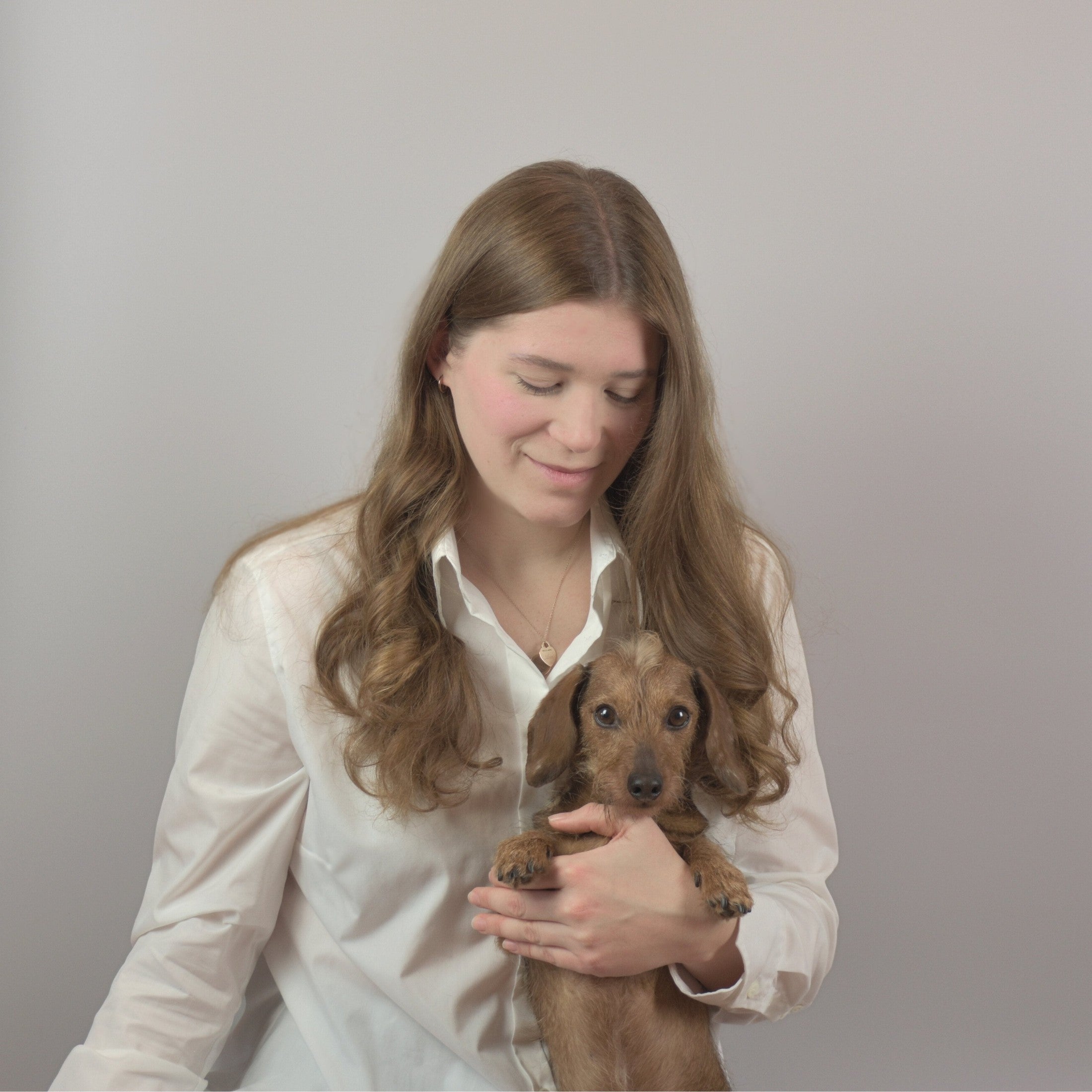
From practice: What has proven effective on walks with Schoko
When I go for walks with Schoko, it always becomes clear that it's not the quantity of equipment that matters, but its designated place.
Poop bags should be accessible without me having to fully open my bag. Treats need to be reachable with one hand. My smartphone, on the other hand, needs a protected compartment so it doesn't come into contact with snacks or keys.
For short walks, I prefer a light, compact solution. If we then go into the city, to a cafe, or travel, a sturdy crossbody dog walking bag is more practical because it can replace my regular bag.
The season also changes the requirements. In summer, a light cotton bag is pleasant and can be cleaned if necessary. In autumn and winter, I more often reach for a leather bag that can be easily combined with a coat and knitwear.
This change has proven more effective in everyday life than trying to cover every situation with a single, as large as possible bag.
Cleaning and care of a dog walking bag
A dog walking bag regularly comes into contact with crumbs, grease, dust, moisture, and road dirt. Proper care therefore doesn't just start with visible stains.
How to clean cotton bags correctly
First, remove all items, poop bag rolls, and loose crumbs. Close zippers and follow the manufacturer's care instructions.
If machine washing is allowed, a laundry net can protect metal parts and the drum. Use a mild detergent and avoid high temperatures unless explicitly permitted.
According to the product specifications, the Cotone dog walking bag from PAWLII can be washed at up to 30 degrees. Afterwards, it should be shaped and air-dried.
How to care for leather bags correctly
Carefully remove dust and surface dirt with a soft, dry or slightly damp cloth. Aggressive household cleaners and complete soaking should be avoided.
Care products must match the specific leather and its surface treatment. Test them first on an inconspicuous area. Too much product can alter the surface or cause stains.
If the bag gets wet, it should dry at room temperature. Direct heat from a heater can dry out leather. For stubborn stains or damage, professional leather care is often the safer solution.
Storing treats hygienically
Empty snack compartments regularly. Even dry treats leave crumbs and grease marks. Moist or homemade snacks should not be left directly in a textile or leather bag compartment for extended periods.
A small washable inner bag or a separate snack container makes cleaning easier. Allow cleaned areas to dry completely before closing the bag again.
Conclusion: The best dog walking bag for dogs fits your everyday life
A good dog walking bag doesn't have to have as many features as possible. It needs to offer the right features in the right places.
For daily use, an easily accessible poop bag dispenser, a sensible separation of treats and personal items, an adjustable strap, and an appropriate size are particularly important. The material then determines how the bag feels, how it is cleaned, and into which situations it visually fits.
Leather is a compelling choice for those who value form, longevity, and a calm, high-quality design. Washable cotton offers advantages when ease of care, light weight, and frequent cleaning are more important. Technical fabrics are particularly suitable for weather-intensive and sporty uses.
The best solution is therefore not the bag with the longest list of features. It's the one you instinctively grab because it organizes your walk, is comfortable to carry, and fits your daily life.